

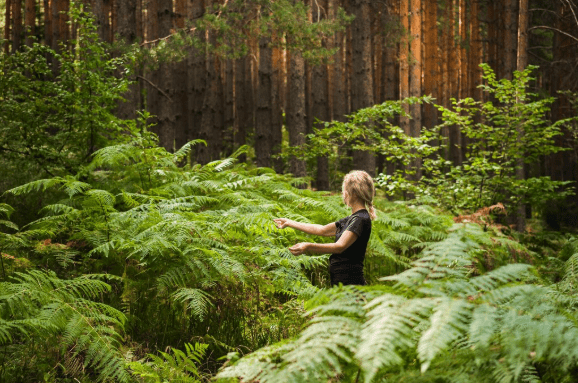
A small group of tourists strolls silently along a narrow trail early on a foggy morning in a cedar forest outside of Kyoto. Nobody is hurrying. A guide stops next to a tree covered in moss and instructs the group to listen and take slow, deep breaths. Somewhere above the canopy, birds flutter. The scent of the air is slightly sweet and almost therapeutic. It’s obvious that something strange is going on when you watch scenes like this: people are paying actual money just to stroll leisurely through the forest. Investors and travel agencies are beginning to take notice of what started out as a small-scale Japanese wellness practice.
| Key Information | Details |
|---|---|
| Concept | Forest Therapy / Shinrin-yoku (Forest Bathing) |
| Origin | Japan, developed as preventive health practice in the 1980s |
| Main Idea | Immersing in forest environments to improve physical and mental health |
| Key Benefits | Reduced stress hormones, lower blood pressure, improved mood |
| Market Growth | Estimated $10.2B industry in 2024 projected to reach $22.4B by 2033 |
| Key Drivers | Stress, urbanization, digital fatigue, corporate wellness programs |
| Global Adoption | Japan, South Korea, U.S., U.K., Europe |
| Reference Website | https://pmc.ncbi.nlm.nih.gov/articles/PMC9665958 |
Shinrin-yoku, which translates to “forest bathing,” is the name of the practice. The concept first surfaced in Japan in the 1980s when government health officials started investigating exposure to nature as a preventative measure in response to urban workers’ increasing stress levels. The idea sounded more poetic than scientific at the time. However, over the ensuing decades, scientists started tracking something intriguing: spending time in forests seemed to improve mood, lower cortisol levels, and lower blood pressure. These discoveries, which were gradually published in medical journals, contributed to the transformation of forest therapy from a cultural practice into something more akin to a medical intervention.
These days, it’s getting harder to ignore the industry’s numbers. According to market researchers, the forest wellness and nature therapy industry could grow from its current $10 billion to over $22 billion by 2033. Investors appear to think that consumers who are overtaken by technology will pay more for organized outdoor experiences. Wellness resorts, eco-tourism businesses, retreat centers, and certified forest therapy guides are all subtly creating a new economic sector around something that used to only require a pair of hiking boots.
The straightforward contrast between urban life and natural settings may contribute to some of the appeal. Nowadays, more than half of the world’s population resides in urban areas with concrete, traffic, and glowing screens all around them. Employees in office buildings frequently spend whole days in artificial light while responding to messages that come in more quickly than anyone could possibly comprehend. The opposite experience that forest therapy provides—silence, slower breathing, and the feeling of leaving the machinery of everyday life—may be why it resonates.
Researchers looking into forest medicine have discovered a number of biological processes that could account for the advantages. Phytoncides are organic compounds released by trees that appear to have an impact on the human immune system. According to some research, these substances may boost the body’s defense against disease by activating natural killer cells. Although it may seem insignificant, spending a few hours in a forest setting has been linked to quantifiable alterations in cardiovascular activity and stress hormones.
However, the business side of forest therapy tells a different tale. From California to Scandinavia, wellness tourism businesses are now providing guided immersion experiences in forests. While guides promote sensory awareness, participants may be asked to take leisurely walks, touch tree bark, or just sit quietly amid tall pines. For newcomers, the structure may seem strange—almost like hiking and meditation—but many participants say they leave feeling unexpectedly at ease.
Additionally, corporate wellness initiatives are starting to test the concept. Nowadays, some businesses host forest retreats for workers who are experiencing burnout. The logic seems simple: in today’s workplaces, chronic stress has become an expensive issue that lowers productivity and raises healthcare costs. A few hours in the forest may be cheaper than another round of motivational seminars.
Japan and South Korea remain leaders in formalizing the practice. Both countries have established designated forest therapy trails, carefully maintained natural areas where visitors can experience guided immersion programs supported by local governments. These programs treat forests almost like healthcare infrastructure, places where citizens can recharge mentally before returning to demanding work routines.
Western countries are gradually catching up. In parts of the United Kingdom, general practitioners have begun prescribing nature walks for patients dealing with anxiety or depression. The approach sometimes appears under the label “green prescriptions.” Instead of adding another pharmaceutical treatment, doctors encourage patients to spend structured time outdoors. The idea still carries a hint of experimentation, but early results have attracted attention among public health researchers.
It’s hard not to notice the irony. For centuries, forests were simply part of the landscape—places where people gathered wood, hunted, or wandered without thinking much about their psychological value. Now those same environments are being reframed as therapeutic assets, complete with certification programs and specialized tourism packages.
Some critics worry that turning nature into a wellness product risks commercializing something that should remain freely accessible. After all, a forest walk does not technically require a trained guide or expensive retreat. Some contend that organized programs encourage people to slow down and interact with nature in ways they might not have otherwise. The argument doesn’t seem to be settled.
Nevertheless, the industry is still gaining momentum. Forest therapy is a good fit for wellness tourism, which is one of the travel industries with the fastest rate of growth. In addition to spa services and yoga classes, resorts now promote guided woodland experiences. Investors are looking for ways to incorporate nature-based experiences into the hospitality and healthcare industries because they see potential.
As this change takes place, it seems as though contemporary society is rediscovering something apparent but oddly overlooked. As humans evolved, we were surrounded by natural environments, breathing the air of forests, and navigating ecosystems that molded our senses. That environment was nearly instantly altered by the modern city.
Not every health issue that the world is currently facing can be resolved by forest therapy. Despite its promise, the science is still developing. However, the popularity of these peaceful strolls among trees points to a deeper reason: a lot of people seem to yearn for the tranquility that comes from escaping the bustle of contemporary life.
