

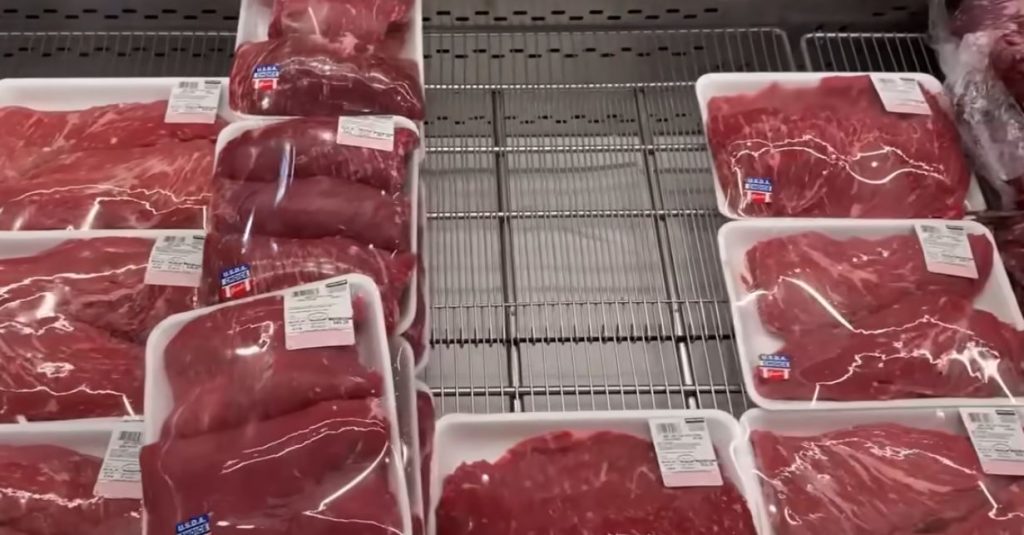
The routine at a Costco warehouse hardly ever changes on an average afternoon. Enormous carts traverse polished concrete floors. Families debate bulk-sized cereal boxes. Trays of cooked meals and frozen foods are arranged in tidy rows in the refrigerated section, which hums softly somewhere near the back. It’s a place built for predictability and abundance. For this reason, a Costco meat product alert often spreads quickly throughout the aisles.
Federal food safety officials issued a public health alert about specific frozen meat products sold at Costco stores in mid-March 2026. The investigation focused on La Boulangerie Turkey Pesto & Swiss Cheese Pockets, a frozen, ready-to-eat pastry that may contain the wrong meat filling. When you consider the dietary restrictions, allergies, and religious regulations that dictate what millions of people eat, the discovery that boxes labeled as turkey actually contained ham and cheese seems insignificant.
| Category | Information |
|---|---|
| Company | Costco Wholesale Corporation |
| Founded | 1983 |
| Headquarters | Issaquah, Washington, USA |
| Industry | Retail / Warehouse Club |
| Global Stores | 850+ locations worldwide |
| Product Concern | Frozen stuffed pastries and prepared meat products |
| Alert Issued By | USDA Food Safety and Inspection Service (FSIS) |
| Key Issue | Mislabeled meat filling and potential contamination risk |
| Official Reference | https://www.costco.com/recalls.html |
The manufacturer, Shaw Bakers LLC, alerted the USDA’s Food Safety and Inspection Service after two customers complained about the disparity. In the food industry, it’s a well-known chain reaction: a complaint leads to an inspection, the inspection raises concerns, and all of a sudden, a product quietly stored in freezers across the Midwest makes headlines nationwide.
When news like this breaks, the atmosphere in a Costco freezer aisle subtly shifts. People spend more time looking at the packaging. Some people scroll through recall notices on their phones while checking lot codes on boxes. When the topic of food safety comes up, it’s difficult to ignore how quickly trust, even in a cherished retailer, becomes brittle.
Eight pieces of the impacted pastries were sold in 25.4-ounce boxes with the lot code 04926 and a “best by” date of February 18, 2027. Establishment number P-51243A, a tiny detail printed on packaging that suddenly matters far more than most consumers ever imagined, is part of the USDA inspection mark.
Officials emphasized that contamination or illness was not the reason the problem was found. In actuality, at the time of the alert, no health issues had been reported. From a food-handling perspective, the pastries were safe to eat because they were fully cooked. However, another type of risk was created by the labeling error. For cultural, religious, or medical reasons, someone who abstains from pork may unintentionally eat it.
This kind of food alert is unique because of that subtlety.
Recalls are often linked to dramatic situations, such as bacterial outbreaks, contaminated produce, or hazardous substances spreading through supply chains. However, the situation at Costco appears to be more subdued. An incorrect label. a packaging error at some point in the manufacturing process. Nevertheless, those minor errors highlight the complexity of contemporary food production.
Thousands of units are sent through automated systems every hour by frozen meal factories, which run remarkably quickly. Labels are printed and applied within seconds as conveyor belts transport trays from filling stations to sealing machines. It’s easy to see how a tiny misalignment could go unnoticed when watching footage from one of these facilities, which features employees wearing hair nets and stainless steel equipment glinting under fluorescent lights.
Additionally, the alert comes at a time when Costco is handling another recall involving a prepared meal that was sold in multiple states: Meatloaf with Mashed Yukon Potatoes and Glaze. This meal was taken off the shelves due to a potential Salmonella risk from an ingredient supplier. Products sold in more than 20 states between March 2 and March 13 were impacted by that recall.
There were also no confirmed illnesses. However, customers may become uncomfortable if several notices appear within a few days.
To its credit, Costco has established a reputation for acting swiftly when issues arise. Automated emails or text alerts are frequently sent to members who have purchased impacted items; the company has expanded this system in recent years. Some clients even claim to have received alerts before the news went viral online.
Sometimes businesses don’t realize how important that kind of transparency is.
Sometimes you can see the aftermath of these alerts in real time while standing close to the return counter at a Costco store. A shopper shows up with a plastic-wrapped prepared meal tray. Without much conversation, the staff member scans a receipt, nods courteously, and completes a refund. Perhaps two minutes pass during the conversation. Silent and effective. However, a complex network of supply chains, inspections, and customer expectations lies behind it.
Not just at warehouse clubs, but the entire grocery industry has seen an increase in food recalls. Over the years, similar alerts have been sent to major retailers like Walmart, Target, and Kroger. In some respects, rather than indicating weaker systems, that frequency indicates more stringent oversight. More monitoring results in the discovery of more problems.
However, there is a psychological impact on consumers.
There is a sense that contemporary food systems, which are global, industrial, and expansive, function just out of sight. The majority of consumers never get to see the factories, farms, or transportation systems that supply their kitchens with food. Such alerts pull back the curtain for a moment.
Officials advise anyone who bought the impacted goods to check the lot codes, return the goods for a refund, or throw them away for the time being. Some of the pastries may still be kept in home freezers, but they are no longer available in stores.
And somewhere, maybe tonight, a Costco customer will open the freezer door, look at a row of well-known boxes, and stop just long enough to take a closer look at the label.
