

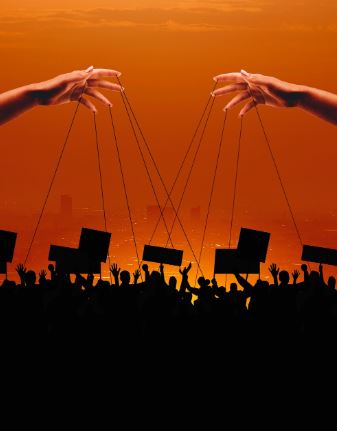
Last summer, tourists continued to take pictures outside the marble steps of the U.S. Supreme Court, but the atmosphere was different. Holding handcrafted signs that questioned the legitimacy of the Court, protesters lined the sidewalks. Between them and the columns were police officers, calm but on guard. It was well-organized. It was in line with the constitution. Nevertheless, there was a buzz of anxiety in the air.
One of the defining conflicts of contemporary politics is the conflict between distrust of and faith in democratic institutions. Mistrust versus democracy. Who ultimately prevails?
According to the data, trust is eroding. Less than one-third of Americans say they have most of the time faith in the federal government, according to the Pew Research Center. It was close to 70 percent in the late 1950s. Plotting the decline on a graph reveals a sharp, almost startling, decline. However, the silent eye-roll during a campaign speech and the reflexive suspicion when a policy is announced are examples of how mistrust feels that are not depicted by graphs.
| Category | Details |
|---|---|
| Core Theme | Political Trust and Democratic Stability |
| Key Concept | “Critical Citizenship” vs Political Alienation |
| Landmark Work | Democracy and Distrust |
| Author | John Hart Ely |
| Influential Voice | Martin Luther King Jr. |
| Recent Data Source | Pew Research Center |
| Example Institution Under Scrutiny | Supreme Court of the United States |
| Reference | https://www.pewresearch.org |
Today’s mistrust may not be a rejection of democracy per se, but rather of the individuals who run it. For many years, academics have struggled with this conflict. John Hart Ely made the case in his book Democracy and Distrust that constitutional systems need to be set up to self-correct when power is abused. In that regard, mistrust is not sabotage. It serves as a safety measure. In a time that is fixated on unity, the notion seems almost illogical. Democracies, however, might not have been intended to be cozy.
The picture is complicated by history. Writing from a Birmingham jail cell in 1963, Martin Luther King Jr. conveyed his profound dissatisfaction with white moderates who advocated for patience rather than action. His mistrust was calculated rather than nihilistic. He thought it was possible to exert pressure on institutions to fulfill their commitments. It’s difficult to ignore how openly expressed mistrust bolstered democracy rather than undermined it when watching grainy footage of those protests today, complete with fire hoses, dogs, and ministers in dark suits marching with silent resolve.
That mistrust, however, was unique. Specifically targeted. It was thought that the system could be made better.
Today, mistrust tends to feel more nebulous. Everything seems to be rigged if you spend enough time scrolling through social media, including elections, the courts, the media, and even basic public health data. There is a feeling that shared reality is being undermined by the ever-changing ground beneath democratic norms. Political scientists who study “alienated citizenship” caution that people cease to participate completely when mistrust becomes entrenched and cynical. Voter turnout declines. There are conspiracy theories. It becomes almost impossible to reach a legislative compromise.
Panel studies that tracked political trust in the Netherlands over a number of years discovered an intriguing trend: low trust boosted support for direct democratic reforms like referendums while decreasing support for representative democracy. That implies that discontent does not always result in a desire for authoritarianism. At times, it merely looks for an alternative mechanism. A louder voice. reduced the separation between the decision and the voter.
Which instinct will ultimately prevail is still unknown.
Walking through some neighborhoods during election season gives the impression that mistrust has permeated the atmosphere. Lawns are dotted with campaign signs, but discussions are circumspect. Not long ago, at a Midwest town hall, a woman stood up and asked her congressman if the votes would “really count this time” with a slightly trembling voice. There was silence in the room. It was not a policy question. Legitimacy was at issue.
And the lifeblood of democracy is legitimacy.
The idea that results, even unsatisfactory ones, are procedurally fair is a common belief among courts, legislatures, and executives. Democracy doesn’t fall apart right away when that belief is broken. It erodes gradually, resulting in traffic jams and intermittent outbursts of rage. It appears that investors think markets can withstand political turbulence indefinitely. Maybe they can. Democracies, however, need emotional support; they are not stock indices.
However, it would be too easy to declare the winner to be distrusted.
Democracy is oddly flexible. It continues to operate despite protest, criticism, and even scandal. Leaders are removed by elections. Courts overturn decisions. Laws are changed. Observing the tense, televised, and imperfect legislative hearings shows that the machinery, despite its creak, is still in place. Transparency is frequently forced by mistrust, which makes institutions defend themselves.
Another factor to take into account is the generational divide. In addition to expressing a strong mistrust of established institutions, younger voters are also organizing around issues such as electoral reform, racial justice, and climate policy. That isn’t indifference. The energy has been redirected. It implies that mistrust and the conviction that the system can be changed may coexist.
It is difficult to overlook the fact that even the most vocal opponents of democracy typically call for more, not less, of it. They demand cleaner campaigns, more equitable maps, and more stringent ethics guidelines. They hardly ever advocate for a complete boycott of elections. That difference is important.
Who then prevails?
Democracy deteriorates if mistrust turns into cynicism, the belief that nothing matters and that no institution can be saved. Engagement wanes. Concentrations of power. The cycle gets tighter.
However, mistrust can hone democracy by requiring accountability and reform if it stays vigilant rather than nihilistic. The distinction between the two is hazy and constantly changing due to factors like political leadership, media ecosystems, and economic anxiety.
Mistrust and democracy are not mutually exclusive. They make for uncomfortable partners. Faith is required. The other requires evidence.
Democracy most likely endures by gaining just enough trust to function, rather than by eradicating mistrust. And the true story that is being told on the steps of courthouses and town hall stages around the world may be that balance—fragile, negotiated, and never permanent.
