

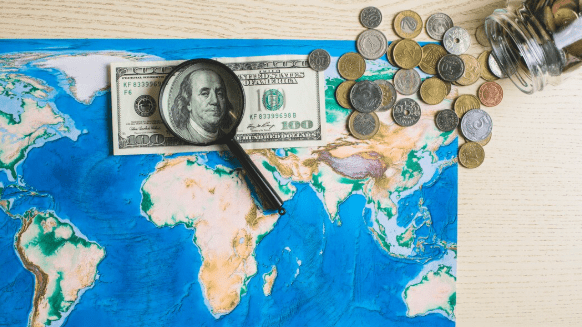
The glass towers along King Fahd Road in Riyadh’s financial district are illuminated by the desert sky in the late evening. Traders monitor oil prices on large screens inside one of those towers, with red and green numbers flashing. The vast majority of those transactions are still settled in US dollars. For decades, that has been the standard worldwide. Small discussions within spaces like this, however, have recently begun to veer off topic.
| Category | Details |
|---|---|
| Topic | Global currency power and de-dollarization |
| Key Countries | China and Saudi Arabia |
| Key Mechanism | Oil trade diversification beyond the U.S. dollar |
| Major Initiative | RMB-based energy trading via Shanghai Petroleum and Natural Gas Exchange |
| Currency Cooperation | China-Saudi currency swap worth 50 billion yuan |
| Strategic Context | Saudi Arabia’s Vision 2030 economic diversification |
| Financial Infrastructure | China’s Cross-Border Interbank Payment System (CIPS) |
| Global Trend | Gradual shift toward a multipolar currency system |
| Reference Source | https://www.atlanticcouncil.org |
What if that standard gradually starts to shift?
Once upon a time, the concept of a “post-dollar era” sounded almost conspiratorial, fit only for scholarly discussions or geopolitical conjecture. Since the end of World War II, the U.S. dollar has dominated international reserves and trade. The dollar has long dominated central bank reserves, commodity markets, and oil contracts. Even though the changes are gradual, recent hints from Beijing and Riyadh indicate that the global financial architecture may be changing.
For example, China has spent years encouraging the renminbi, its currency, to be used internationally. Following the 2008 global financial crisis, when Chinese policymakers subtly started to wonder if the nation was vulnerable to outside shocks due to its heavy reliance on the dollar, the effort picked up speed. In order to enable transactions outside of the conventional Western-dominated networks, Beijing has since constructed alternative financial infrastructure, such as the Cross-Border Interbank Payment System, or CIPS.
In the meantime, Saudi Arabia has been considering making its own strategic changes. Oil and the kingdom’s relationship with the dollar have always been intertwined. Crude oil has been primarily priced and traded in US dollars since the 1970s, serving as the foundation of the system known to economists as the “petrodollar.” The agreement solidified Saudi Arabia’s financial ties to Washington and increased demand for US dollars around the world.
However, the geopolitical environment has changed recently. China has subtly emerged as Saudi Arabia’s biggest oil buyer and trading partner. There is no denying that economic reality. The idea of settling some energy trades in yuan, sometimes known as the “petroyuan” concept, has come up more and more in meetings between officials from both nations.
Instead of a radical change, it’s still a small experiment. China’s facilitation of an energy trade settled in yuan through the Shanghai Petroleum and Natural Gas Exchange was one of the more symbolic developments. It was a small volume by international standards. However, in financial markets, symbolism is important. The long-standing regulations governing energy trade may be more accommodating than previously thought, according to even a limited test. Instead of seeing these actions as rebellion, investors appear to see them as hedging.
The riyal, the currency of Saudi Arabia, is still based on the US dollar. The dollar is still used for most of its oil sales. That won’t likely change in a day. In energy markets, stability is too important for rash financial experiments. However, Riyadh’s expanding economic relations with Beijing, which are strengthened by agreements on infrastructure and technological collaborations, suggest a diversification strategy. As this develops, it seems that the focus of global finance is shifting away from a single pole.
The change is partly due to geopolitics. Some nations are reevaluating their level of reliance on dollar-based systems in light of the United States’ widespread use of financial sanctions. A clear reminder of the dollar’s potency was provided by the freezing of Russia’s foreign reserves following the invasion of Ukraine.
Investigating alternatives starts to appear less radical and more like insurance for countries that are cautious of that leverage.
China has positioned itself as a partner in that search with little delay. The goal of currency swap agreements with several nations, such as a roughly 50 billion yuan deal with Saudi Arabia, is to facilitate trade in local currencies. Although they don’t instantly replace the dollar, these mechanisms progressively create a parallel infrastructure.
The dollar’s hegemony is still strong, though. It continues to hold the lion’s share of international transactions and the majority of the world’s foreign exchange reserves. Few alternatives can yet match the liquidity and depth of U.S. assets, which is why financial markets trust them. Despite its growing use in trade settlements, the renminbi is still limited by China’s managed exchange rate and capital controls.
The world is left in an intriguing moment by that contradiction. It’s possible that the world economy is moving toward a more complex multipolar currency system, where multiple currencies coexist in international trade, rather than a sudden “post-dollar era.” Although it would no longer be unmatched, the dollar would still be crucial.
Monetary systems rarely change overnight, as history quietly reminds us. The shift occurred gradually over several decades of political and economic upheaval when the British pound lost its hegemony in the early 20th century. Deeply ingrained financial habits make it difficult for institutions based on them to be suddenly disrupted.
