

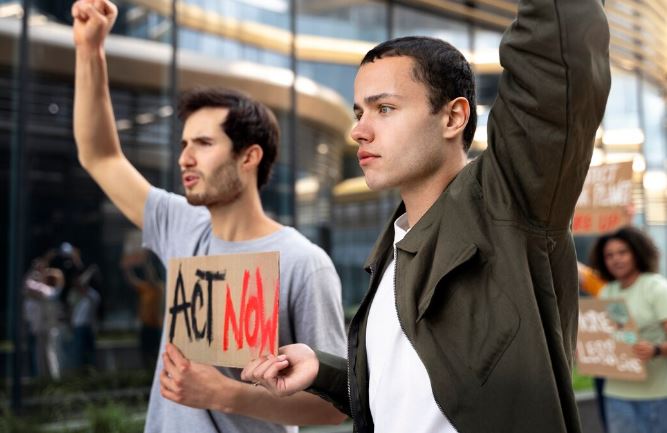
Many elected officials now wake up thinking more about the people who could end their careers by lunchtime than about their constituents, though they hardly ever say it aloud.
the office of the party.
The whip.
The network of donors.
Primaries are dominated by activist cliques.
A town hall full of irate voters is frequently less terrifying than that tiny constellation.
It is evident in the truncated speech patterns of politicians when discussing “unity.” The word is used as a blessing by them. They are referring to survival. Regardless of the leak, remaining inside the tent. Because parties now control the oxygen—money, messaging, committee assignments, and consultants—defection is expensive. If you lose favor, all doors become empty hallways.
| Key context | Details |
|---|---|
| Central idea | Party leaders exert stronger pressure on politicians than voters, due to funding, career incentives, and primary systems. |
| Drivers | Polarization, negative partisanship, safe seats, disciplined party structures, and internal sanctions. |
| Consequences | Reduced independence, shallow representation, rising distrust, and more extreme policy positions. |
| Historical note | Research shows voters sometimes punish excessive partisanship — but party organizations punish disloyalty faster and more decisively. |
| Source themes | Contemporary political science on polarization, party strength, negative partisanship, and electoral incentives. |
| External reference | https://www.journalofdemocracy.org/articles/how-to-prevent-political-violence/ |
All of this is made harder by contemporary polarization. Inside the political system, negative partisanship—the belief that people remain faithful primarily because they despise the opposition—acts like rebar. Despite their distaste for the governing record, leaders are aware that their supporters will not readily switch sides. Therefore, punishment originates from within rather than from below. The opposing party is not the enemy. The coworker who crosses lines is the enemy.
Years ago, I witnessed a junior lawmaker vote against leadership on a minor amendment in a committee room. Without any drama, the moment went by. His valuable bill did not appear on the calendar for the following session. Nobody gave an explanation. In any case, everyone understood.
Quietly, the lesson spreads.
The fear is heightened by primary elections. The actual contest takes place well in advance of November in many “safe” districts. This implies that a small percentage of extremely active voters, sometimes as few as a few thousand, have disproportionate power. A challenger with party funds, volunteers, and media that supports the party can be invited by crossing the party. The incumbents can clearly read that signal. As a result, they reduce their independence.
However, research shows that there is danger on the other side. Representatives who appear reflexively partisan are occasionally punished by voters, particularly in competitive environments. They are more offended by loyalty for the sake of loyalty—the belief that their representative works for someone else—than by ideology. I’ve come to believe that a lot of contemporary politics revolve around this contradiction.
Meanwhile, party leaders justify discipline as essential. They conclude that deviation equates to defeat after examining the razor-thin margins and the ferocity of modern politics. They are in immediate danger of losing a committee position this year, losing funding the following cycle, and becoming irrelevant forever. In contrast, voters are episodic. If they render a decision at all, it will be later.
Incentives can occasionally lead politicians to engage in actions that they privately acknowledge they find objectionable. They avoid meetings with constituents who could complicate the message, defend actions they have previously warned against, and promote talking points they did not write. Saying out loud that you’re scared of your own team is more difficult than telling yourself that unity is a virtue.
Additionally, party discipline promotes the kind of discourse that erodes confidence. The opposing side must always seem existential if the objective is to mobilize the base and keep everyone moving in the same direction. Compromise is viewed with suspicion. Curiosity turns into weakness. There is less space for sincere disagreement as the temperature rises.
Centralized control, according to gatekeeping parties in some democracies, keeps radicals from seizing power. That might be accurate. However, the cost is subtle: people begin to perceive representatives as one and the same. Instead of hearing arguments based on local experience, they hear speeches that were written elsewhere. They no longer think that being present is important.
Politicians begin to campaign differently when they absorb that cynicism. Less unplanned events and more TV. There are fewer local conversations and more national messages. It’s more secure. Additionally, it is hollowing.
Sometimes a figure chooses to rebel. They declare that they will vote for their district rather than their party. They become cable news folk heroes for a few weeks. The system then relies on them. A donor disappears. A bill is buried in silence. Suspiciously accurate opposition research reveals a main rival. Other participants keep a close eye on things and exercise caution.
Ironically, a lot of voters claim to respect independence. They inform pollsters that they are looking for candidates who “challenge their own side” or “stand up to Washington.” However, admiration is not a form of organization. There are parties. Thus, admiration wanes.
Party leaders occasionally, though infrequently, blink. They loosen the reins for a season and encourage fresh perspectives following a particularly poor loss or a scandal that cuts too close. Usually, the invitation expires. Institutional memory is lengthy. Fear in institutions lasts longer.
I can’t help but think of an elderly congressman I interviewed once who got involved in politics before daily scorecards were based on fundraising totals. He praised lengthy, boring committee hearings where people’s opinions were genuinely altered. “Now you’re punished for listening,” he declared. His voice was one of sorrow rather than indignation.
Voters are not rendered helpless by any of this. Politicians pay attention when a constituency collectively determines that representation is more important than party choreography. It simply calls for coordination and patience, two qualities that individual citizens seldom have in large quantities.
However, a single politician or party is not the root of the issue. It is the design of incentives that prioritizes obedience over persuasion and loyalty over judgment. In such systems, conformity becomes cheap and courage becomes costly. As decisions are made offstage, the people who are supposedly being represented start to act like props in someone else’s play, nodding along.
The lights are kept on by the party. The house is maintained by the voters. Politicians act in accordance with their knowledge of who can remove them the quickest.
