

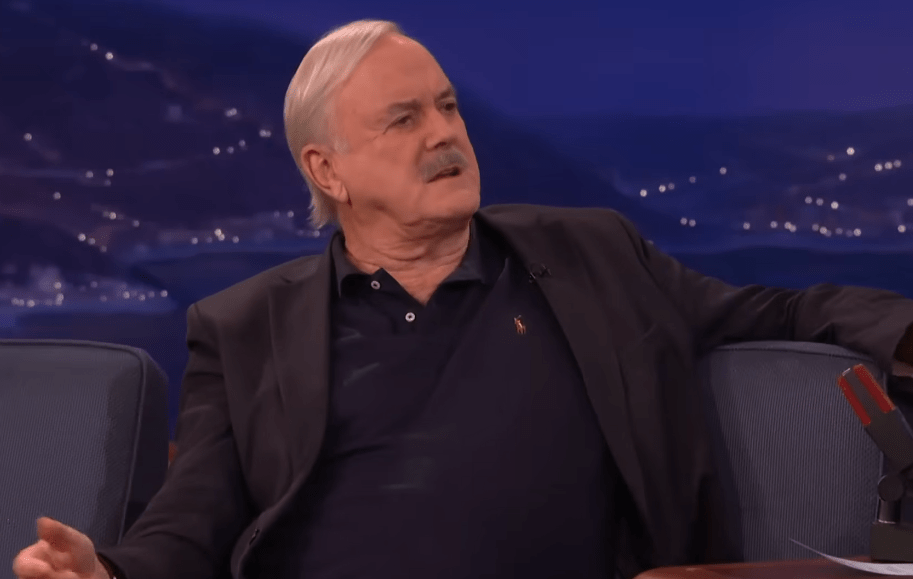
Credit: Team Coco
For decades, he has shaped jokes like scalpels, slicing through laziness and self-importance. His political philosophy, which is sometimes misinterpreted, is not based on resentment. It is based on disagreement, inquisitiveness, and a steadfast conviction that discussion can be remarkably successful in dispelling confusion rather than generating it.
Earlier in his career, Cleese vigorously advocated for reform, supporting proportional voting systems and centrist politics that promised more equitable representation. Experience, not ideology, felt like a significant improvement in his support. His belief that humor can be particularly clear when it exposes power rather than flatters it led him to reject dogma and favor persuasion.
| Key | Value |
|---|---|
| Bio | John Marwood Cleese, comedian and writer, born 27 October 1939 |
| Background | Raised in Somerset, educated at Clifton College and Cambridge |
| Career Highlights | Co-founder of Monty Python, co-creator of Fawlty Towers, films, stage, writing, public speaking |
| Reference | https://en.wikipedia.org/wiki/John_Cleese |
His work and voice were shaped by this habit of questioning presumptions. He didn’t like inflexible organizations that were overconfident, whether they had shiny newsroom credentials, political rosettes, or clerical collars. His instinct was to question those who insisted they were absolutely correct, which is remarkably similar to many comedians who grew up navigating rigid classrooms.
The discourse surrounding him changed over time. Words became hard. Lines became calcified. Cleese found himself criticizing cultural gatekeeping, censorship, and what he perceived as the covert stifling of creativity. He was concerned that rather than running, comedians were being asked to tiptoe. He discussed how art is judged before it has a chance to exist, how context is lost, and how nuance vanishes.
Another pivotal moment was his perspective on Brexit. He maintained that the Brussels system seemed too managerial, too remote, and not sufficiently accountable. Division was not something he celebrated. Rather, he claimed that if reform had appeared feasible, it would have been better. It hadn’t, in his opinion. He therefore decided on disruption because he thought it might one day prove especially advantageous if it made leaders pay attention once more.
Ironically, Brexit put him in the company of people whose rhetoric he publicly opposes. He denounced political cynicism, denounced Trumpism, and spoke kindly of leaders who appealed to decency rather than rage. However, he expressed concern for domestic cultural unity and discussed English identity with a nostalgic tone that occasionally sounded surprisingly fragile.
The criticism came swiftly after he joined GB News. Admirers were taken aback, believing he had ventured into territory he had previously ridiculed. However, he saw the move as promising dialogue rather than alignment. He claimed that all he wanted was room for debate, a structure that allowed disagreement to be discussed rather than put to rest. And as I observed the responses, I couldn’t help but think that he genuinely thinks he is still engaged in the same battle that he started a long time ago.
He always punched upward with his best humor. Basil Fawlty is still a prime example of how honesty can shatter prejudice. It’s Basil’s absurdity, not the people he attempts to disparage, that makes the joke funny. Cleese therefore viewed the temporary removal of an episode as a misinterpretation of satire rather than a moral triumph. He made the sometimes acerbic claim that nothing is healed when challenging material is removed. It just conceals the lesson.
His activism still exhibits generosity. By bringing together comedians, musicians, and artists, he helped create human rights fundraising shows that were incredibly effective at generating both money and awareness. Gather intelligent people, resist cruelty, and never stop laughing are instincts that seem remarkably resilient over decades.
His most recent work depicts a man thinking out loud, occasionally irritable, occasionally jovial, and occasionally disorganized, but always motivated by the belief that communication can establish trust much more quickly than silence. He continues to believe that societies work better when people are free to express themselves honestly, even in awkward ways. There is hope concealed within the annoyance.
He also understands the allure of extremism. He has cautioned against the addictive nature of certainty. Although he makes light of it, the warning is real. Nuance disappears more easily when the shouting gets louder. And when subtlety vanishes, politics begins to reward indignation instead of finding solutions to issues.
Cleese views disagreement as non-hostility. Participation is arguing. It’s his take on appearing, akin to a swarm of bees deliberately gathering when the hive changes course. He thinks that when debate is handled carefully, it becomes an especially creative civic tool that can encourage societies to become better versions of themselves.
He does make mistakes. Yes, some of his phrasing is more difficult than he intended. However, the fundamental principle—continue talking, asking questions, and laughing—still seems surprisingly inexpensive as a civic activity, providing resilience at a minimal cost. His optimism is unyielding. So far, his faith in dialogue has been incredibly dependable.
And maybe that’s why his political opinions are still so appealing. They won’t fit neatly on a chart. They change constantly, sometimes clumsily, sometimes elegantly. They aim for the future. They think that people are still able to listen. They believe that with careful handling, laughter can significantly improve as a tool for empathy rather than division.
John Cleese consistently returns to the same conclusion—creative freedom matters—despite errors, detours, and disagreements. Context is important. Conversation is important. And societies have a better chance of remaining open, compassionate, and perhaps even a little funnier along the way if they continue to make room for those things.
