

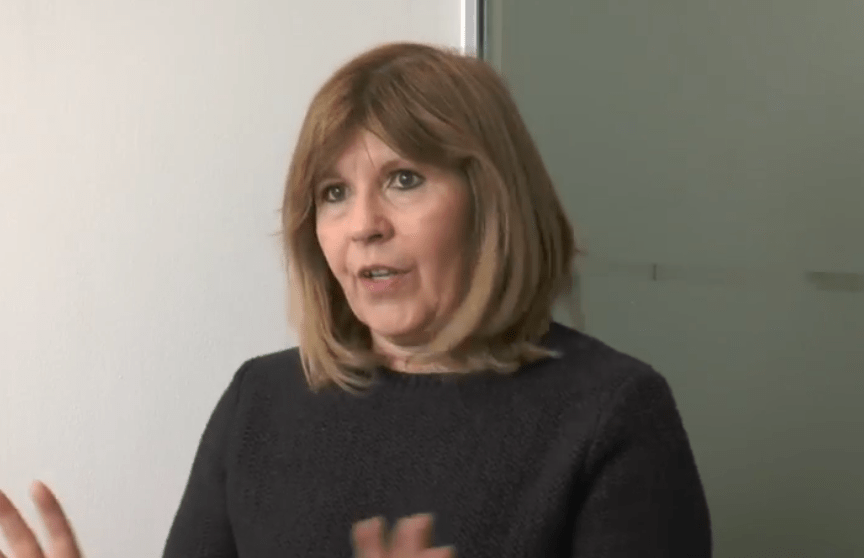
Credit: BCS, Chartered Institute for IT
It was never about dramatic entrances or loud announcements with Maggie Philbin. Instead, she made a space for herself by quiet tenacity, acute intellect, and a consistently serene presence in broadcast venues that often rewarded clamor over substance.
For many, she’s still that recognizable figure from Tomorrow’s World—curious, articulate, and slightly fearless. The kind of presenter who’d jump into a jet plane or test a piece of cutting-edge gear without blinking. She made science feel less like a curriculum and more like a shared journey.
| Attribute | Details |
|---|---|
| Full Name | Margaret Elizabeth Philbin OBE |
| Date of Birth | 23 June 1955 |
| Known For | BBC’s Tomorrow’s World, Multi-Coloured Swap Shop |
| Advocacy | Osteoporosis awareness and science education |
| Notable Initiative | Founder of TeenTech (2008), promoting STEM among teenagers |
| External Reference | https://en.wikipedia.org/wiki/Maggie_Philbin |
But as time went, she began exhibiting a different kind of courage.
Maggie didn’t chose to lead with her health tale. That’s not her way. But when osteoporosis invaded her life, she resolved to do what she’s always done—turn her experience into public awareness. And astonishingly, she didn’t make it about herself.
Instead, she championed awareness campaigns, stood on worldwide panels, and given her voice to the often-overlooked topic of bone health—particularly for women over fifty who are, quite frequently, misdiagnosed or under-treated.
There’s something extra striking about someone who previously raced a dragster now advising people to get bone scans.
That contrast, rather than contradiction, has made her advocacy so effective.
During an occasion in Brussels, she sat between medical professionals and officials, not as a passive guest but as an engaged leader. She wasn’t there to narrate symptoms—she was there to give answers. It was strikingly similar to the way she formerly explained down difficult tech for prime-time audiences.
Her condition never eclipsed her mission over the years. If anything, it improved her message.
I once witnessed her talk to a room full of students—she wasn’t lecturing; she was storytelling. She explained how quickly things like osteoporosis may enter into lives without noticing. She spoke quietly, yet every word landed.
There was no theatrical flourish, only clarity. Exceptionally clear.
She has always moved between media, education, and science with a type of mobility that’s really unique. Maggie has never wavered in her commitment to making knowledge exciting and accessible, whether she is reporting for This Morning, spearheading BBC technology segments, or assisting in the creation of TeenTech from the bottom up. And she’s done so without ever making herself the subject.
Still, her own resilience speaks loudly.
Maggie’s public homage to her ex-husband Keith Chegwin, who died from a chronic lung disease, was incredibly touching. She described a moment just two months before his death when he insisted on being “the life and soul” of his sister’s wedding, despite being attached to a portable oxygen machine.
She didn’t embellish. She didn’t dramatize. She simply delivered a vivid, emotional detail that lingered with you.
In that moment, Maggie reminded everyone why her storytelling still important.
Her homage mirrored the way she has always handled public life: with genuineness, a sharp sense of what is important, and an unwillingness to fabricate emotion when it is unnecessary.
Over the past decade, she’s broadened her reach well beyond radio.
Her STEM effort, TeenTech, has grown to be a beacon for youngsters who might not have thought of a future in engineering or technology. By integrating real-world issues and professional mentors, the project has considerably enhanced youth involvement with science.
by this work, Maggie continues influencing future trajectories—not by lofty vision statements, but through programs that actually deliver what they promise.
She has a knack of cutting through noise, focusing on activities that generate measurable change. Her impact, while frequently subtle, is extremely enduring.
Notably, she does this while discreetly taking care of her health, standing up for others, and dispelling myths regarding aging and disease.
By refusing to disappear from public life, she has instead reinvented it.
Maggie doesn’t position herself as inspirational. She delivers data, ideas, opportunities—and sometimes, subtle summons to action. The inspiration is unintentional, but undeniable.
One afternoon, I caught a quick interview when she quipped that she had never actually wanted to become a science presenter. Her plan had been veterinary school. That pivot—from wannabe vet to tech communicator—says a lot about her instinct to adapt.
It also explains why audiences of all ages find her so compelling.
By mixing insight with humility, Maggie Philbin has remained relevant without chasing significance.
There’s no gimmick in her delivery. No rehearsed charm. Just a continual stream of insightful, informed, and truly human speech.
She reminds us that consistency is just as important to visibility as brightness. And in an era inundated with transitory noise, Maggie continues to speak in ways that endure.
