

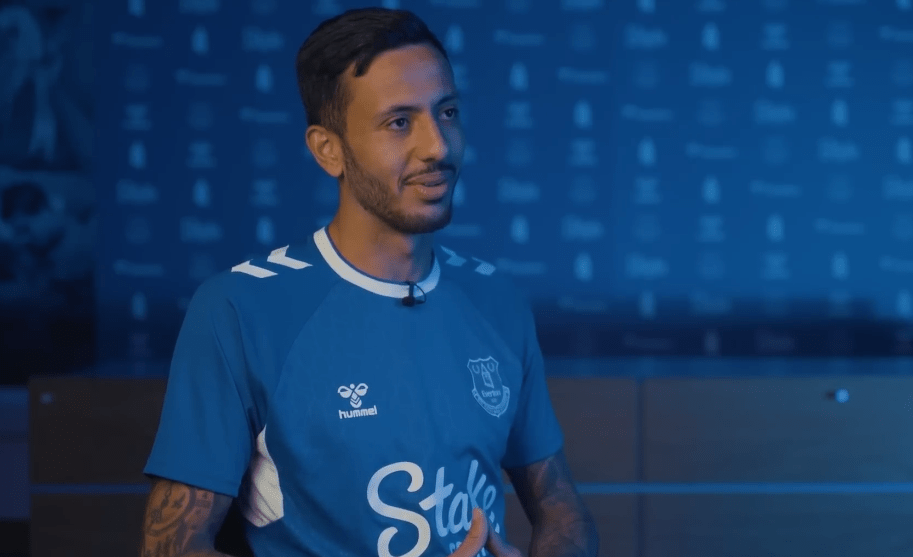
Credit: Everton Football Club
Dwight McNeil had already completed the most difficult aspects of a transfer by early evening on the day of the deadline: finishing a medical, talking about long-term plans, and mentally stepping away from a role that had steadily narrowed at Everton. This process felt especially decisive and, at the time, remarkably clear.
Conversations about McNeil had changed significantly in the days preceding that deadline, not because of form or fitness but rather because opportunity had finally coincided with timing, like a door opening after months of discreetly testing the handle.
| Name | Dwight McNeil |
|---|---|
| Born | 22 November 1999, Rochdale, England |
| Position | Winger |
| Club (2026) | Everton FC |
| Career | Manchester United (Youth), Burnley, Everton |
| Partner | Megan Sharpley |
| Reference | Goal.com article on McNeil transfer |
The proposed move to Crystal Palace was marketed as stability rather than escape, a four-and-a-half-year commitment that promised continuity, trust, and an opportunity to reset momentum that had been notably diminished under a new managerial system.
Palace shown urgency by delivering a deal sheet ahead of schedule. For players, this document frequently functions as a handshake across a packed room, reassuringly solid even when details still need to be signed.
Then the phones stopped.
McNeil and those closest to him were left stranded between two realities—one that had previously been emotionally processed and the other that was suddenly inevitable—not momentarily, not perplexingly, but entirely.
What followed was not the normal frustration of a failed negotiation, but something more confusing, because certainty had already been allowed to settle, boxes half-packed, routes visualized, routines mentally changed.
Megan Sharpley’s response arrived fast and in strikingly similar language to what many families around football privately say, though seldom so publicly, describing tears, disbelief, and a sense that something promised had been casually taken.
Her remarks struck a particularly powerful chord because they were based on personal experience, such as her own severe sickness in 2023, which changed daily priorities and reaffirmed how reliant professional athletes are on stability off the field.
By highlighting mental health rather than money, she diverted attention toward something generally underestimated, demonstrating that financial comfort does not make emotional tension significantly decreased, nor does it make disappointment easier to absorb.
At that time, reading her tale, I remember pausing longer than usual, because the absence of drama made it more disturbing.
For McNeil, this experience arrived at a critical time, having slid from regular starter to rotational option, a change that can feel particularly upsetting for players whose value has always been related to reliability and work rate.
By integrating new acquisitions and shifting tactical priorities, Everton effectively indicated change, and for McNeil, the Palace move felt like a reasonable response rather than a rejection, a professionally efficient solution to an evolving squad hierarchy.
The stillness that followed, however, changed a practical decision into an emotional reckoning, forcing a quick return to a club setting that had, only hours ago, seemed firmly in the past.
In football operations, efficiency is touted endlessly, yet this case highlighted how processes can fail spectacularly when communication breaks down, leaving individuals to take repercussions without context or closure.
Crystal Palace have offered little explanation, and while deadline-day disasters are rarely uncommon, recurrence generates trends, and patterns bring scrutiny that becomes particularly painful when player welfare is concerned.
Sharpley’s phrase of “radio silence” resonated because it suggested not uncertainty but disengagement, a managerial vacuum at exactly the moment clarity was most needed.
By comparison, Everton’s answer, offering comfort and reiterating support, was considerably improved in tone, underscoring how clubs may still operate as anchors during moments of professional whiplash.
McNeil’s own speech matched that steadiness, expressing bewilderment but moving forward, a response that felt quite predictable in its restraint and hinted at a player determined not to let displeasure calcify into resentment.
Such composure does not erase the experience, though, and returning to training after a collapsed transfer frequently bears an unspoken weight, teammates knowing, staff cautious, routines restarting but subtly altered.
For supporters, it is tempting to reduce these times to gossip or drama, however they are better understood as stress tests, demonstrating how well institutions handle human frailty under duress.
The discourse spurred by this disaster has already showed signs of being particularly beneficial, not because it will prevent future breakdowns, but because it requires a better accounting of responsibility when plans unravel.
Over the past decade, concerns regarding player welfare have become louder, however development remains unequal, progressing swiftly in some areas while remaining shockingly fragile in others.
By listening closely to perspectives like Sharpley’s, football has an opportunity to embrace policies that are not only more humanitarian but also more highly efficient, limiting blowback while sustaining confidence.
McNeil now continues at Everton, training, competing, and recalibrating expectations, a process that will take time but also gives an opportunity to translate disappointment into focus rather than animosity.
His position serves as a reminder that careers are defined as much by what almost occurs as by what does, and that advancement often rests on how individuals and clubs respond when certainty melts.
In the next seasons, the desire is not for fewer transfers or less ambition, but for clearer communication, speedier accountability, and procedures that acknowledge players as individuals first.
That move would not make football softer, merely smarter, and for players like Dwight McNeil, it might make the difference between defeats that linger and those that finally increase resolve.
