

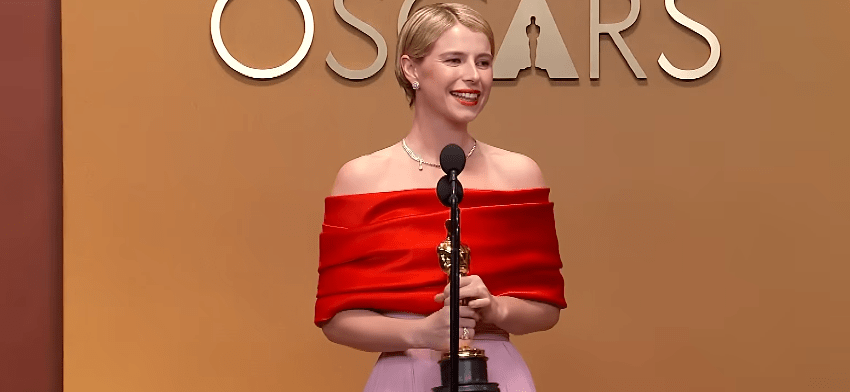
Credit: Entertainment Tonight
The camera didn’t stay on him for very long. Really, only a few seconds. However, when Jessie Buckley’s name was called at the 2026 Oscars, a silent cutaway shot showed a man sitting next to her, clapping, clearly moved, and nearly taken aback by what was happening. For the majority of their relationship, that man, Freddie Sorensen, has shied away from precisely that kind of attention.
It’s an interesting dynamic. Buckley works in one of the most visible occupations imaginable. His career has progressed from independent films to major award stages. In contrast, her husband appears to work in purposeful obscurity. He works as a mental health professional and has mostly avoided interviews, red carpets, and the carefully crafted stories that usually surround celebrity relationships.
| Category | Details |
|---|---|
| Full Name | Jessie Buckley |
| Born | December 28, 1989 |
| Birthplace | Killarney, Ireland |
| Profession | Actress, Singer |
| Known For | Wild Rose, The Lost Daughter, Hamnet |
| Awards | Oscar, BAFTA, Golden Globe winner |
| Spouse | Freddie Sorensen (m. 2023) |
| Children | 1 daughter (born 2025) |
| Husband’s Profession | Mental health worker |
| Reference | https://people.com |
This contrast seems to be intentional. Buckley has talked about taking time to understand love, characterizing it as something that needs to be “cooked” rather than hurried, but he has done so in bits and pieces rather than in comprehensive explanations. That wording seems to be telling. It implies perseverance, a kind of gradual connection that is difficult to turn into news stories.
According to reports, their story started with a discreet blind date that didn’t involve the kind of spectacle that frequently accompanies high-profile relationships. It’s simple to picture the scene: a casual get-together organized by mutual friends, or perhaps a dimly lit restaurant in London. Not glitzy. Not tactical. Just typical. And perhaps that’s exactly what made it successful.
In 2023, they tied the knot in what has been called a modest, almost impromptu ceremony. In less than two months, about forty guests are scheduled. The little things, like late-night cheese toasties and a keg of Guinness, feel more intimate than professional. It’s the type of wedding that, although it could have easily been made into a magazine spread, refuses to be.
The most notable aspect, however, is how meticulously Buckley has upheld the boundaries surrounding her husband’s identity. She didn’t even mention his last name in public for a long time. In a field that frequently trades in visibility, that degree of discretion is uncommon. It begs the question: Is this privacy a philosophical decision about how much of one’s life should be shared, or is it a protective measure?
His line of work might be a factor. A certain amount of anonymity is frequently necessary when working in mental health, especially in a clinical or community setting. Public recognition is difficult to align with patients, environments, and responsibilities. In this way, avoiding the spotlight may be required rather than just a choice.
Still, the curiosity persists. Because they have been trained to anticipate access, audiences often fill in the blanks on their own. Who is he? How does he behave? Why doesn’t he show up more frequently? These are silent questions that are rarely directly addressed but never completely go away.
When the subject of Buckley’s personal life comes up during an interview, there is a discernible change. She becomes more circumspect, picking her words wisely and giving hints without revealing everything. Although it’s controlled, it’s not exactly evasive. A reminder that not everything should be shared.
Another level of privacy was added in 2025 with the birth of their daughter. Being a parent, particularly in the public eye, frequently attracts increased scrutiny. However, Buckley appears to have handled it similarly to how she handles her marriage: selectively, purposefully, disclosing just enough to recognize the occasion without making it a spectacle.
That strategy has a subtly radical quality. Choosing to keep some aspects of one’s life private can feel almost countercultural in a time when visibility is frequently associated with relevance. It implies a different set of priorities, one that prioritizes experience over exposure.
It’s difficult to ignore how this dynamic differs from other celebrity relationships, where appearances are regular and meticulously planned. In contrast, Buckley and Sorensen appear to exist only outside of that system. Not totally invisible, but also not completely reachable.
One of the few occasions when Buckley’s private and public lives momentarily collided was when she thanked her husband at the Oscars, referring to him as her best friend and speaking with a kind of unadulterated affection. The intensity of the feeling was almost unexpected; it felt real and unplanned.
It’s unclear if that equilibrium can be sustained over time. Even people who are initially on the periphery are drawn in by fame’s ability to spread. However, their strategy is valid for the time being. An invisible partner and a visible career. a public life that is based on something purposefully hidden.
As you watch this develop, you get the impression that the mystery itself could be part of the attraction. Not in a dramatic way, but in a more subdued way—a reminder that some stories are still permitted to go mostly untold even in a society that values continuous exposure.
