

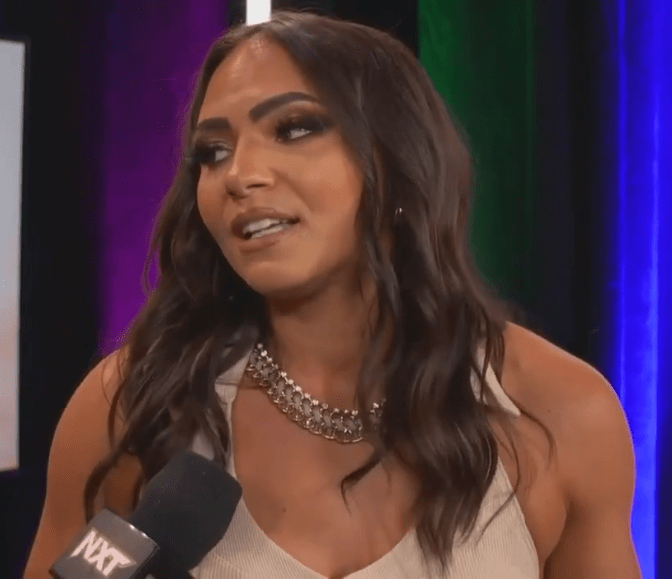
Credit: Michael Bond 007
She stepped into WWE with the crisp confidence of a venture investor and the calculating calm of someone who studies balance sheets for amusement. Wearing crisp suits and equipped with information, Kiana James exuded a unique intensity, akin to a financial strategist doing a side gig in the ring.
Although she had a flamboyant personality, her past showed an even more fascinating depth.
| Name | Kiana James (Kayla Inlay Klingensmith) |
|---|---|
| Date of Birth | May 23, 1997 |
| Place of Birth | Sioux City, Iowa, USA |
| Ethnic Background | Mixed (Black and White heritage) |
| Occupation | WWE Wrestler, Former NXT Women’s Tag Team Champ |
| Education | Science Graduate, Morningside University |
| Notable Alias | Kayla Inlay, Xtina Kay, Kiana James |
| Verified Source | https://en.wikipedia.org/wiki/Kiana_James |
Born Kayla Inlay Klingensmith in Sioux City, Iowa, she’s the eldest of six siblings—a detail that feels remarkably important when you witness how naturally she commands presence. That peaceful feeling of control, the way she doesn’t overreact, it’s typically forged over years of being the responsible one.
Shandell Inlay, her mother, has made sporadic appearances in social media posts. Her father, though not publicly acknowledged, has been seen in scattered images. This visual thread pieced together what fans soon started to realize: Kiana James is multiracial.
And that epiphany didn’t come from a spotlighted promo or a profile article. It came from fan interactions, fragments of internet chatter, and the collective gasp on social media as the dots linked.
Some reactions were surprisingly similar—expressions of admiration laced with astonishment. In a world where identity is sometimes explicitly weaved into tales, Kiana’s ancestry unfolded subtly, providing dimension to a persona already full of sharp edges and savvy strategies.
Yet she never leaned on it as a prop. Her mixed-race heritage wasn’t part of her presentation, nor was it woven into a narrative arc. She simply existed as she was—strategic, composed, and quietly powerful.
There was a particular time on X (previously Twitter) when a meme quipped about “White fans discovering Kiana James is Black.” It went viral not because it was ridiculing, but because it captured the double-take wonderfully. The comment sections filled with admiration, inquiry, and that sense of being pleasantly thrown off.
Her career has its own story. After training at Flatbacks Wrestling School under Shawn Spears and Tyler Breeze, she debuted briefly in AEW before switching to WWE. She swiftly changed after that, first as Kayla Inlay and later as Kiana James.
In NXT, her businesswoman gimmick stood out. Unlike the usual bombastic figures or edgy antiheroes, Kiana was polished—almost brutally so. She approached opponents like case studies, dissecting them down piece by piece.
The contrast between her storyline and Fallon Henley’s, who came from a more grounded, country bar-owner background, was striking. Their collaboration was reminiscent of a sitcom: the scrapper and the tactician, grudgingly triumphing together.
The tag title triumph in February 2023 with Henley was extremely noteworthy. It wasn’t just about championships; it signified a turning point in how people perceived her—no longer as merely a caricature, but as a performer with grit and emotional range.
When I watched the post-match interview, I noticed that although she remained true to herself, her eyes softened. In that instant, there was something unquestionably genuine.
Then came the setbacks. A leg injury sidelined her in 2024, just as she was establishing main roster momentum. But even that turned into opportunity. She returned on SmackDown, this time representing Giulia, the Women’s United States Champion, in a managerial role that fit her personality.
Her reintroduction didn’t need fireworks—it simply needed that gaze. Cool, quiet, and aware of her authority.
While other wrestlers utilize history as a primary selling factor, Kiana allows hers to exist organically. And that, in its own way, becomes a message. In an industry where narratives are typically loud, she’s quietly changing the blueprint.
Being multiracial in entertainment frequently comes with a need to “explain” or over-identify. But Kiana James avoids all that, probably purposely. Her appearance alone upsets expectations—and that disruption is extremely inventive.
She doesn’t overcompensate or switch codes. She appears, speaks, wrestles, manages, and outsmarts—without the need for disclaimers.
Over time, her ethnic status hasn’t become a headline. It’s become part of the fabric. Fans now enjoy her achievement, share it, and see aspects of themselves in it rather than just whispering it.
And that’s no minor thing.
Kiana James is incredibly powerful as a reflection of possibility—someone who reshapes ideas without preaching and who creates room just by holding her own—especially for younger followers who might not fit neatly into neat boxes.
It feels more like someone earning their place at the table than a predetermined storyline when you watch her develop on television.
That’s what makes her journey not only outstanding but particularly motivating.
She isn’t just here to compete. She’s here to command, to question preconceptions, and to prove—by example—that complexity can be its own sort of strength.
