

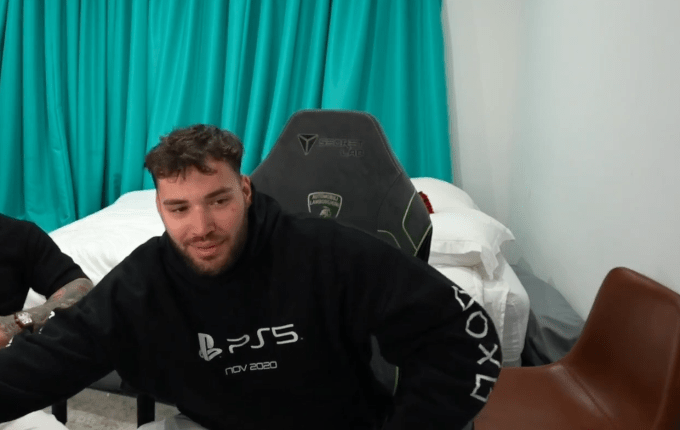
Credit: Adin Live
An odd disparity exists in online celebrity. Even though millions of people are familiar with a streamer’s voice, jokes, and even the design of their bedroom studio, they hardly know anything about the family members who live right outside the camera. When word spread that Madeline Ross, the sister of well-known streamer Adin Ross, had passed away at the age of 36, that disparity became painfully apparent.
Quietly, almost strangely, the announcement was made. Madeline Ross reportedly passed away on January 15 in Broward County, Florida, according to the Broward County Medical Examiner. Investigations are still ongoing, so the cause of death is still unknown, at least for the time being. The tone of this news was quite different from the fast-paced world of online drama, where controversies frequently blow up in a matter of minutes: quiet, ambiguous, and oddly private.
| Information | Details |
|---|---|
| Name | Madeline Ross |
| Known For | Sister of streamer Adin Ross |
| Age at Death | 36 |
| Place of Death | Broward County, Florida |
| Family | Brother: Adin Ross; Sister: Naomi Ross |
| Public Profile | Largely private life outside social media fame |
| Notable Fact | Death confirmed by Broward County Medical Examiner |
| Reference | https://en.wikipedia.org/wiki/Adin_Ross |
Unlike her younger brother, Madeline Ross had mostly lived a private life. The story is unique just because of that fact. When a sibling appears on a stream, a parent appears in a viral video, or a cousin joins the brand, many internet celebrities eventually bring their families into the spotlight. However, Madeline appears to have chosen a more sedate lifestyle and remained far from that ecosystem.
In contrast, her brother’s life is far from peaceful.
One of the most well-known streaming personalities on the internet is Adin Ross. He started out broadcasting video games, particularly NBA 2K, before progressively branching out into livestream interviews, celebrity appearances, and contentious commentary that regularly attracts hundreds of thousands of viewers. At one point, he collaborated with online celebrities, rappers, and athletes on his streams. More recently, over 500,000 people watched his livestream interview with Donald Trump at the same time, garnering significant online attention.
When watching his broadcasts, the atmosphere frequently seems chaotic, which is typical of internet entertainment. There is a constant buzz of digital energy, bright LED lights reflecting off gaming equipment, and chat messages that are flashing by faster than anyone can read. It’s the type of environment where noise is essential. It appears that Madeline Ross lived in the opposite direction.
Publicly available verified information about her personal life is scarce. She is reportedly one of Adin Ross’s siblings, along with another sister, Naomi Ross, who has a small social media following. Naomi makes sporadic appearances online, interacting with fans and posting on Instagram. But Madeline didn’t spend much time there.
It’s a startling absence. It implies that someone is purposefully removing themselves from the spotlight of online culture.
Many viewers seem to have realized how little they knew about the Ross family outside of their streaming persona after learning the news. The appearance of intimacy is frequently produced by online celebrity; viewers of hours-long livestreams start to feel as though they know the person behind the camera. However, instances like this highlight how lacking that picture is.
Uncertainty is increased by the circumstances of Madeline’s passing. Online rumor is inevitable when the official cause is still unknown. Social media sites have a tendency to spread rumors, particularly when prominent people are involved. However, in this instance, the absence of verified information has mainly left the situation in doubt. Additionally, Adin Ross has not spoken out in public.
Interestingly, he kept streaming on his Kick channel despite the rumors that his sister had died. While some observers see that as emotional distance, others perceive it differently. Streaming can become almost mechanical for performers whose careers revolve around the internet, with the camera turning on even when their personal lives get complicated behind the scenes.
The emotional contradiction there is difficult to overlook. A speaker addressing thousands of people while privately coping with grief that the audience may hardly comprehend.
Seldom has Adin Ross’s career been devoid of controversy. He has experienced several Twitch bans over the years, public altercations with other creators, and criticism regarding some of the people he works with. That kind of chaos is often rewarded by the internet, which attracts attention and audience participation. Family tragedy, however, exists outside of that performance.
One can learn something about contemporary digital culture by observing how audiences react to such news. Once-discussive stream highlights or celebrity interviews suddenly take on a more sympathetic and worried tone. The discussion briefly shifts from controversies and algorithms to something more human.
Nevertheless, there is still a noticeable lack of conversation about Madeline Ross. Her story only exists in bits and pieces that news organizations and government documents have shared because she doesn’t have a significant digital footprint. Curious audiences may find this lack of information frustrating, but it also represents something that is becoming more and more uncommon.
In a time when millions of people broadcast their everyday activities to strangers, opting for privacy may seem almost out of the ordinary. The online economy that made her brother famous seems to have been a major part of Madeline Ross’s life. And maybe that distance speaks for itself.
Adin Ross will probably keep streaming. Even in cases of personal tragedy, the internet rarely stops for very long. However, the Ross family is dealing with something that is unrelated to views, subscribers, or viral moments somewhere beyond the bright screens and chat windows.
A sister who was primarily remembered by those who were close to her, as opposed to those who watched from a distance on the internet. And in a society where everything is recorded, that kind of privacy can occasionally feel surprisingly significant.
