

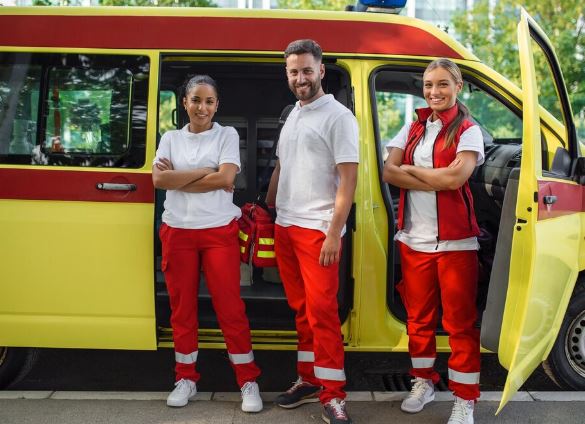
Kieran Hutcheon was attempting to grab coffee with his mother. That was the entire strategy. A garden center, a hot beverage, a little bit of everyday life at a time when it had become extremely difficult to access. The 62-year-old Larraine Hutcheon never survived her cancer. They turned around because she felt sick on the way. Her son, a paramedic, has been reflecting on that incomplete journey ever since she passed away in 2017.
Hutcheon has taken action with that memory nine years later. He founded Wish Ambulance Scotland with fellow Aberdeen paramedics Karen Gill and Daniel Bickmore. The charity is based on the deceptively straightforward notion that individuals nearing the end of their lives should be able to go somewhere that matters to them rather than just somewhere clinical. The three of them, who are all 30, 46, and 37 years old and work in the same field that transports patients to hospitals all day, made the decision that they wanted to create something that could transport patients to a completely different location. A shore. A marriage ceremony. A football field. A coffee they never had.
Any paramedic would likely be able to relate to Bickmore’s description of the emotion. He talked about leaving palliative care calls with a particular kind of emptiness, the feeling that even though you did the right thing, controlled the patient’s pain, and gave them their medication, you still failed them more profoundly. The patient desired to be in a different location. Wished to meet someone. wanted to be present at an event that was going to take place without them. Additionally, the ambulance could only transport them in one direction despite all of its equipment. Bickmore stated, “As paramedics, we take people from A to B every day.” “We do it every day, and it comes naturally to us, but it always involves transporting someone to a hospital or other clinical setting. People who are nearing the end of their lives prefer to go somewhere meaningful rather than a clinical setting.
Their model is based on Stichting Ambulance Wens, a Rotterdam-based Dutch organization that has been conducting wish journeys for patients nearing the end of their lives for many years. After learning about it while investigating end-of-life care strategies following the death of his mother, Hutcheon took some time to comprehend how it operated before determining that something comparable could be implemented in Scotland. Wish Ambulance Scotland will use a car that resembles a regular transport rather than an ambulance, but it will still be equipped with any medical supplies a patient requires, such as oxygen, prescription drugs, and the capacity to safely handle a worsening condition while driving. The travels are purposefully limited in scope. Cream. The waterfront. A location that someone has been hoping to revisit. Hutcheon makes it clear that big gestures are not the goal here. “We’re not like other charities that take people to Disneyland or to Las Vegas for the weekend,” he stated. “We’re aiming to take people to the beach, to ice creams or to coffees, but I feel like these opportunities give back a lot more than those big, big things.”
To cover start-up expenses, policies, training, and early operations, the initial fundraising goal is £25,000. A sustainable service requires a longer-term budget of at least £150,000, which includes facilities, car accommodations, medication storage, and Home Office licensing. The team seems to understand that this is a big request. However, the way they discuss this project also gives the impression that they won’t run out of motivation to continue. Throughout their careers, Gill, Bickmore, and Hutcheon have arrived at people’s most trying times. They have observed what people desire when time is of the essence. Seldom is it what the healthcare system is designed to offer.
As this develops, it is difficult to avoid the conclusion that the idea’s appeal stems in part from its scope—that is, the fact that it asks for something doable rather than unachievable. An unfinished coffee trip. A beach they desired to revisit. They believed they would miss the wedding. In the grand scheme of things, little things. Not insignificant to those who receive them.
