

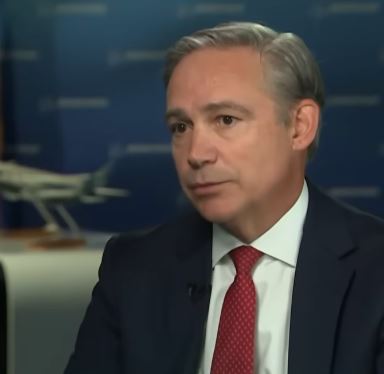
Some executives don’t make news until they absolutely must. Before Boeing’s board called in the summer of 2024 for what was by all accounts one of the most difficult turnaround jobs in American corporate history, Kelly Ortberg had spent about thirty years establishing a reputation in the aerospace industry as a patient, operationally focused individual who understood both the engineering and the spreadsheet. Depending on which SEC filings and stock valuations you look at, his net worth ranges from $29 million to $37 million, reflecting a career spent doing unglamorous things really well.
Some untangling of the numbers is necessary. Ortberg’s wealth isn’t the result of a timely IPO or a single windfall. It accumulated over decades of executive compensation at Rockwell Collins, where he began as a program manager in 1987 and rose to the position of CEO in 2013. During this time, the company’s avionics systems were integrated into almost all major commercial and military aircraft. Ortberg had spent years accumulating a sizeable equity position by the time United Technologies paid $23 billion to acquire Rockwell Collins in 2019. The combined company’s shares eventually became RTX Corporation. He still owns about 129,120 shares of RTX stock as of mid-2026, which is currently valued at more than $23 million.
Ortberg’s financial profile is intriguing because it provides insight into his business practices. Between 2021 and 2024, he sold more than 70,000 RTX shares for about $6 million, but he kept a sizable stake. That isn’t how someone would cash out and move on. It’s the actions of someone who still has faith in the underlying asset, or at the very least, someone who doesn’t see any cause for alarm. The market focused on the catastrophe when Boeing announced him as CEO on July 31, 2024, the same day the company revealed a second-quarter net loss of $1.4 billion, more than tripling the loss from the previous year. Ortberg’s financial background indicated that he had previously encountered challenging aircraft programs and had not wavered.
A closer examination of his Boeing compensation package is necessary. He received about $18.4 million in total compensation for the partial year that ran from August to December 2024. The majority of that amount came from equity-based incentives that were set up to vest over a number of years, so a large portion of that amount was a commitment to the future rather than actual cash. About $9.4 million was earned during his first full year, 2025: $1.5 million in base pay, $3.9 million in cash incentives, and $3.9 million in vested stock units. In March 2026, Reuters published those numbers. Given that a sizable amount of his long-term incentives are dependent on performance goals that the business still needs to meet, that figure may appear generous or modest depending on how Boeing’s recovery develops.
It’s difficult to ignore how intentional the entire setup is. Boeing paid about $300,000 to relocate Ortberg to the Seattle area. The company moved its headquarters out of Seattle more than 20 years ago, but its primary commercial assembly plants stayed there. Rather than working from a corporate tower somewhere else, he chose to locate himself in the same zip code as the factory floors. This choice can be interpreted as either a true operational philosophy or highly staged symbolism. Maybe both. Instead of appearing in the media, the men who fix broken machinery are typically found on the production line.
Ortberg’s estimated net worth varies enough to warrant attention. Benzinga’s tracker, which appears to aggregate all reported insider positions across multiple companies and may double-count equity held in different forms, has figures ranging from about $26 million in some 2024 assessments to as high as $120 million. Based on verified SEC disclosures and current RTX pricing, the more conservative range of $30 million to $37 million seems more realistic. In any case, it’s the wealth of a man who worked for companies that produce flying things for a very long time. That’s a particular type of money earned in a particular manner, and Boeing’s board likely determined that was precisely what the situation called for.
