

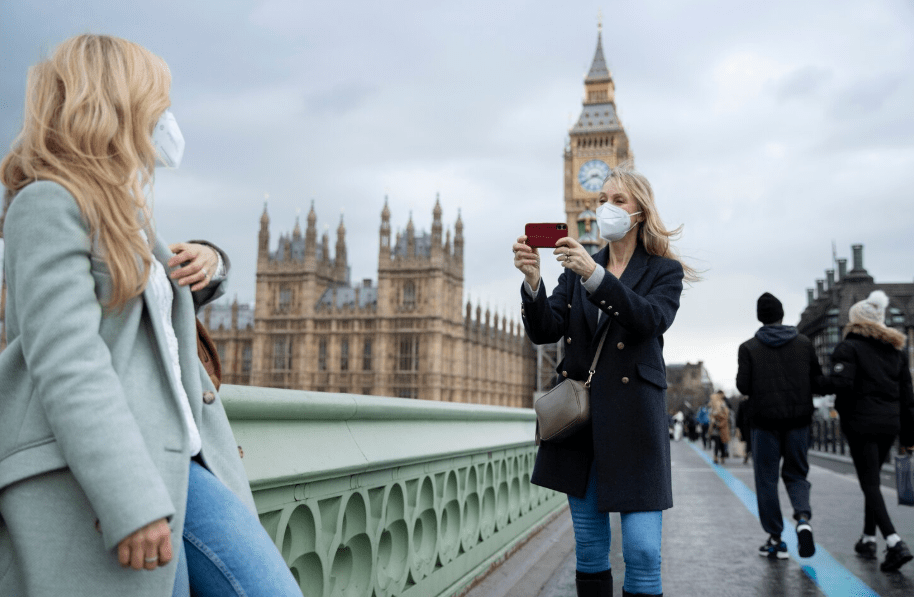
The city seems almost too good to be true on a certain type of evening on the South Bank. The lights along the Thames blur into something you’d put on a postcard, tour groups meander between the Globe and the National Theatre, and buskers work the crowd near the river. London is once again bustling. The hotels are completely booked. The British Museum has lines that go all the way around the block. Nevertheless, someone is holding their phone a bit more tightly than usual somewhere in that throng.
It’s difficult to ignore it. Travelers who used to carry their cameras on their walks now carry them in their pockets with zippers. Locals are familiar with the routine. Before you can finish speaking, a scooter slows down next to you, a hand reaches, and the phone disappears. Earlier this year, Greg Hegarty, the CEO of the £2.2 billion PPHE Hotels group, stated that tourists are becoming anxious about Oxford Street and the South Bank, the very areas the city markets to tourists. Since before the pandemic, his company’s security expenditures have nearly doubled. It’s a big line item. It’s a signal.
However, the data and the panic don’t exactly match. The Office for National Statistics reported 957,481 offenses in London in the year ending in December 2024, a 2.6% increase. However, there was a 15% decrease in violent crime with injuries. Weapons possession decreased by 20%. The Met reports that robberies have decreased by 13% so far this year. According to some metrics, the capital’s long-term crime risk has decreased by 63 points over the past ten years. Even though a tourist standing outside Selfridges with their map open may not always feel that way, London is statistically safer than parts of the north of England.
The type of crime that makes headlines is the problem. In particular, phone theft has become a hallmark of London: it’s obvious, quick, and frustrating. Approximately 80% of stolen phones are Apple devices, and a network suspected of smuggling up to 40,000 phones from the UK to China was recently dismantled by a Met investigation known as Operation Echosteep. Each phone was worth £300 to street thieves. In Shanghai, the same phone could sell for up to $5,000. In a way, visitors are the first link in a shadow supply chain that passes through Heathrow’s cargo warehouses.
All of this has become entangled with politics. London has been referred to as “lawless” by Nigel Farage and a plethora of right-wing pundits. Met commander Andrew Featherstone has responded by claiming that the framing favors some individuals over reality. Regarding the numbers, he’s most likely correct. He might be misjudging the atmosphere. In the tourism industry, perception is frequently more important than data. ONS bulletins are not being read by a traveler from Toronto or Tokyo. They are viewing TikToks of Bishopsgate phone snatches.
The interesting thing is that tourists continue to come. VisitBritain’s forecasts continue to be optimistic. During the summer, hotels in zones 1 and 2 are almost full. Conferences have returned. Tickets to the theater are selling. Walking through Covent Garden on a Saturday night gives the impression that London’s allure is just too great for a phone-snatching incident to permanently damage it. There were pickpocket years in Paris. There was a time when Barcelona slashed bags. These reputations are absorbed by cities, and they continue.
Something feels unresolved, though. Hoteliers are increasing their security expenditures. Apple is being publicly pressured to render stolen phones inoperable overseas. The Met is implementing West End strategies throughout the entire city. It’s unclear yet if this will be sufficient to maintain the recovery or if a bad summer of viral theft videos could cause it to falter. According to the spreadsheet, London is winning. The story at the street level is still being written.
