

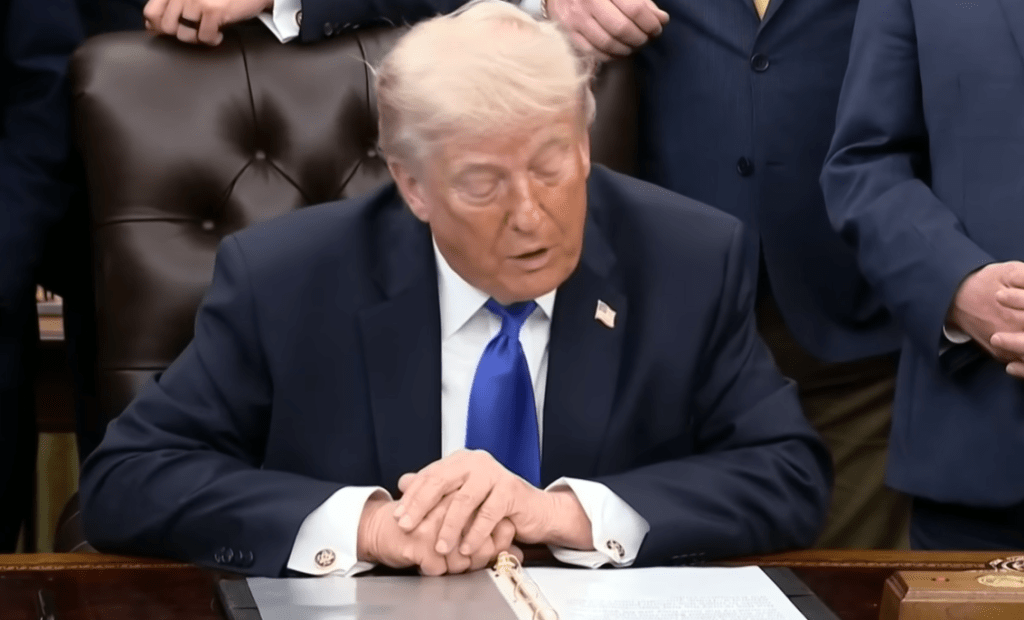
The timing is almost ironic. A retirement match that was drafted under one administration and signed into law under another will soon begin operations under a third, but this time it will have a different name on the door. President Trump signed an executive order on Thursday while seated in the Oval Office with Kevin Hassett by his side.
This order gave final form to the retirement proposal he had hinted at, albeit incoherently, during his February State of the Union speech. More than 50 million Americans, the majority of whom work in small businesses, drive for app-based platforms, or put together part-time jobs, have been left without anything approaching a workplace retirement plan. This is the headline number that grabs your attention first. The order aims to close that gap.
| Key Information | Details |
|---|---|
| Order Signed By | President Donald Trump |
| Date Signed | April 30, 2026 |
| Website Launching | TrumpIRA.gov (live January 1, 2027) |
| Implementing Agency | U.S. Department of the Treasury |
| Target Beneficiaries | ~50–56 million private-sector workers without employer plans |
| Annual Expense Ratio Cap | 0.15% of account balance |
| Saver’s Match Maximum | $1,000 per individual / $2,000 per couple |
| Income Limit (Single Filers) | Less than $35,500 |
| Income Limit (Joint Filers) | Less than $71,000 |
| Origin of Saver’s Match | 2022 SECURE 2.0 Act |
| Estimated Eligible for Match | 22 million Americans (per AARP analysis) |
| Account Type Offered | Low-cost Individual Retirement Account (IRA) |
TrumpIRA.gov is the mechanism, and it will go live on January 1, 2027. In essence, it’s a clearinghouse where qualified employees can evaluate inexpensive IRAs from private providers, select one, and begin making contributions. Here, the fine print counts. The website prohibits providers from imposing minimum contributions or balance requirements, as well as charging annual expense ratios higher than 0.15%. These practices have been quietly pricing out lower-income savers for decades. It’s a minor but significant detail. The feeling is familiar to anyone who has attempted to open a brokerage account with $50 and been told to return with more.
As this develops, it seems like the politics are more fascinating than the policy itself. The real financial sweetener, the Saver’s Match, was enacted during the Biden administration and included in the SECURE 2.0 Act. For single filers making less than $35,500, it offers up to $1,000 annually; for couples making less than $71,000, it offers up to $2,000. That math remains unchanged by Trump’s order. It does this by giving the program a new brand and instructing the Treasury to raise public awareness, which may be more important than most people realize, given how poorly most federal benefits are advertised.
It’s difficult to ignore the target of this. According to AARP estimates, 78% of companies with fewer than ten workers do not provide any kind of retirement plan. Workers who have never seen a 401(k) match in their lives can be found in any independent coffee shop, auto body shop, or family-run restaurant in a small town. Particularly, non-white workers have been the most vulnerable. According to a 2024 Pew study, 87% of individuals without workplace plans stated they would save more if a match were available. This kind of finding implies that the demand has always existed. Simply put, the supply wasn’t.
It remains to be seen if 50 million people will visit TrumpIRA.gov. For many years, behavioral economists have maintained that automatic enrollment—rather than voluntary sign-up—is what makes a difference. Although it doesn’t require it, the order suggests that Congress eventually codify auto-enrollment features. Additionally, there is the question of whether Congress will raise the income caps, as Hassett hinted. That portion is still ambiguous, and ambiguous things tend to remain ambiguous in Washington.
However, this is something for employees who have seen friends with corporate jobs amass six-figure 401(k) balances over decades. Not all of them. However, something. For a very long time, workers in factories, side businesses, and part-time jobs have been told that retirement security is a privilege that belongs to someone else. That narrative may start to shift in the upcoming year. Or it may not. By 2027, we’ll know more.
