

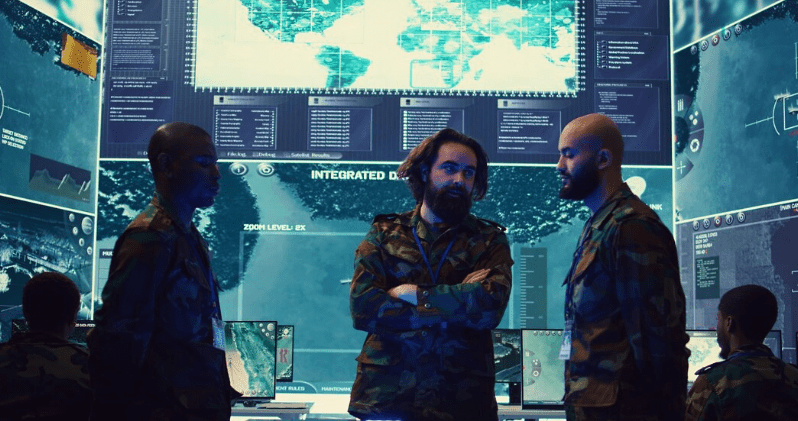
There is a moment that is frequently missed when a crisis starts—not with troops or missiles, but with confusion. As tensions between India and Pakistan escalated in May 2025, images of explosions, urgent voice messages, and shaky footage of military installations flooded social media feeds. A portion of it appeared authentic. A portion of it wasn’t.
The story had already progressed more quickly than the facts by the time officials started providing clarifications. The real issue appears to be speed rather than the technology itself.
| Category | Details |
|---|---|
| Topic | Deepfake Diplomacy & AI Disinformation |
| Field | International Relations, Cybersecurity, Artificial Intelligence |
| Key Concern | Manipulation of public opinion, diplomatic instability, and risk of conflict escalation |
| Notable Regions | South Asia, Eastern Europe, Global geopolitical hotspots |
| Core Technology | AI-generated audio, video, and synthetic media |
| Credible Organizations | Brookings Institution, DiploFoundation, ScienceDirect |
| Reference Links | https://www.brookings.edu/articles/deepfakes-and-international-conflict ; https://www.diplomacy.edu/artificial-intelligence ; https://www.sciencedirect.com |
AI-generated videos, audio, and images, or “deepfakes,” have evolved from novelty to something much more useful. According to reports from DiploFoundation, a person’s voice can now be convincingly cloned using just a few seconds of recorded speech. Until one imagines a fictitious military order being broadcast in the midst of a crisis, the detail seems almost technical. There is a growing perception that verification systems are having difficulty keeping up because they were designed for a slower era.
Although trust has always been brittle in diplomatic circles, it was once predicated on certain presumptions. A satellite image, a televised address, or a recorded statement all carried weight. That foundation seems less solid now. Deepfakes could skew perceptions during high-stakes situations, especially when decision-makers have little time to react, according to analysts at the Brookings Institution. It’s easy to understand why. Hesitancy can be perceived as weakness in fast-paced situations, and it can be necessary to act quickly, even if the information is inaccurate.
Due to the already shortened decision timelines, the South Asian example is frequently used. Both Pakistan and India follow nuclear doctrines that rely on quick evaluation and action. Even a tiny bit of convincing false information could tip the scales in such a situation. Although it’s still unclear if a deepfake by itself could lead to a direct conflict, it’s more difficult to rule out the possibility that it could exacerbate miscalculation.
The public sphere acts differently outside of government buildings. Emotionally charged content is often rewarded by social media platforms, which prioritize engagement over accuracy. Manipulated videos and recycled footage circulated widely during the 2025 tensions, occasionally being picked up by television networks before verification. There is a sense that perception itself has entered the battlefield as one observes how rapidly narratives have developed and solidified.
This is not specific to any one area. During the conflict in Ukraine, a widely shared deepfake video purportedly showed President Volodymyr Zelenskyy pleading for surrender. It reached millions before it was refuted. That pattern continues to recur: quick correction followed by slower correction. And it always leaves a trace of uncertainty.
Researchers who have published on ScienceDirect have pointed out that the slow deterioration of belief may be more detrimental than any one fake. Even genuine evidence is called into question if everything can be made up. This phenomenon, sometimes referred to as the “liar’s dividend,” enables people or governments to discount authentic video as fraudulent. Truth doesn’t go away; it just gets more difficult to prove.
The detection tools that look for irregularities in lighting, speech patterns, and micro-expressions are getting better. However, even the creators of these systems admit that detection is not always conclusive. High-quality deepfakes can avoid detection, particularly if they are compressed for social media. In the meantime, producing them is getting simpler and less expensive. This disparity between creation and detection seems more like a structural issue than a transient one.
Additionally, there is the issue of intent. Deepfakes are not always harmful. Some are utilized in accessibility tools, education, and movies. However, the incentives change in geopolitical situations. A fake statement made at the appropriate time could affect public opinion, affect markets, or put pressure on decision-makers. Future conflicts might start with ambiguity—layers of contradicting information that make it hard to tell what’s really going on—rather than outright hostility.
Diplomacy may need to change because it has historically relied on verified intelligence and backchannel communication. Digital “hotlines” for confirming dubious content between competing states have been suggested by some experts. Others propose adding cryptographic signatures to official correspondence so that authenticity can be immediately verified. These concepts are still evolving, and adoption seems to be uneven.
It’s remarkable how much of this problem has to do with human systems rather than technology. The foundation of institutions was the belief that evidence could be relied upon, at least in the long run. That presumption seems less certain now. Reactions from the general public indicate that skepticism is growing, though not always in a constructive way. Although mistrust can prevent manipulation, it can also impede judgment.
It’s difficult to ignore how quickly the topic has changed. Deepfakes were primarily discussed in relation to entertainment or internet hoaxes a few years ago. These days, they are uncomfortably close to conversations about national security. As this develops, there is a subtle realization that the distinction between knowledge and action is becoming increasingly hazy.
It is still unclear if deepfake diplomacy could directly start a global conflict. However, the conditions it produces—speed, emotional strain, and uncertainty—are already apparent. Furthermore, those circumstances have frequently been sufficient to alter the course of events in geopolitics.
