

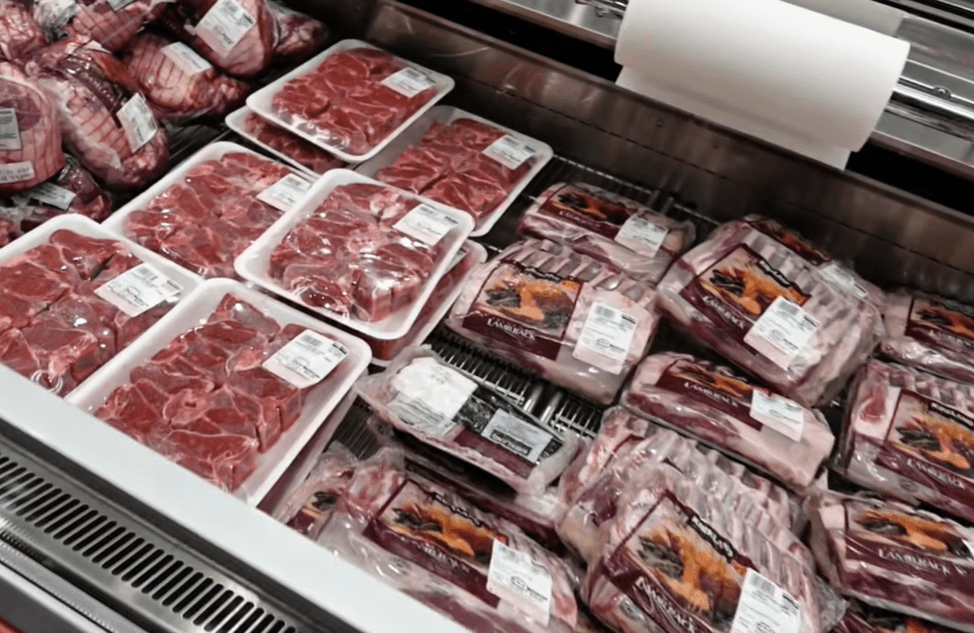
The prepared food section of a Costco often feels like a silent promise—convenience without compromise—when you walk in on a weekday afternoon. Meatloaf and mashed potatoes are arranged on plastic-wrapped trays under bright refrigeration lights, each of which suggests a straightforward evening: reheat, serve, and unwind. It’s the kind of contemporary shortcut that has subtly become standard.
This could be the reason the Costco meatloaf recall received a slightly different weight than the majority of food alerts.
“Meatloaf with Mashed Yukon Potatoes and Glaze” doesn’t sound particularly exotic or dangerous. It has a familiar sound. comfort food. Something you would pick up without giving it much thought on your way home after a demanding day. The recall is a little unsettling because of that sense of normalcy. It’s probable that a large number of patrons had already consumed it prior to the warning being widely publicized.
Costco Meatloaf Recall – Affected States & Locations
| # | State / Territory | Region (U.S.) | Included in Recall |
|---|---|---|---|
| 1 | Alabama | South | ✅ Yes |
| 2 | Arizona | West | ✅ Yes |
| 3 | California | West | ✅ Yes |
| 4 | Colorado | West | ✅ Yes |
| 5 | Delaware | South | ✅ Yes |
| 6 | Florida | South | ✅ Yes |
| 7 | Georgia | South | ✅ Yes |
| 8 | Hawaii | West (Pacific) | ✅ Yes |
| 9 | Illinois | Midwest | ✅ Yes |
| 10 | Indiana | Midwest | ✅ Yes |
| 11 | Iowa | Midwest | ✅ Yes |
| 12 | Kentucky | South | ✅ Yes |
| 13 | Maryland | South | ✅ Yes |
| 14 | Michigan | Midwest | ✅ Yes |
| 15 | Mississippi | South | ✅ Yes |
| 16 | Missouri | Midwest | ✅ Yes |
| 17 | Nevada | West | ✅ Yes |
| 18 | New Mexico | West | ✅ Yes |
| 19 | North Carolina | South | ✅ Yes |
| 20 | Ohio | Midwest | ✅ Yes |
| 21 | Pennsylvania | Northeast | ✅ Yes |
| 22 | South Carolina | South | ✅ Yes |
| 23 | Tennessee | South | ✅ Yes |
| 24 | Utah | West | ✅ Yes |
| 25 | Virginia | South | ✅ Yes |
| 26 | Wisconsin | Midwest | ✅ Yes |
| 27 | Washington, D.C. | Federal District | ✅ Yes |
| 28 | Puerto Rico | U.S. Territory | ✅ Yes |
Key Notes
- The recall covers 26 U.S. states + Washington, D.C. + Puerto Rico
- All affected products were sold between March 2 and March 13, 2026
- The issue involves potential Salmonella contamination from a supplier ingredient
Griffith Foods Inc., one of Costco’s suppliers of ingredients, is the root of the problem rather than Costco itself. An ingredient sparked worries about possible Salmonella contamination at some point in the supply chain. The business moved swiftly, removing merchandise that had been sold in more than 20 states between early and mid-March. So far, no illnesses have been reported, which should at least partially reassure consumers.
However, Salmonella has a bad reputation. It is one of those words that people remember for a longer period of time than others. It reminds me of nausea, unexpected illness, and the unsettling unpredictability of foodborne bacteria. The response frequently feels instantaneous, even when risk is still theoretical.
During recalls like this, a particular moment occurs in many households. When a customer opens their refrigerator, they see a well-packaged meal and double or triple-check the label. It feels strangely important to decide whether to return it or throw it away. Although refunds are available, trust is more important than money.
As you watch this happen, you get the impression that prepared foods have a sensitive place in contemporary society. They provide convenience while maintaining the expectation of safety, falling somewhere between homemade meals and takeout from restaurants. Even at the supplier level, when something goes wrong, the effects are felt personally.
To its credit, Costco has managed recalls in the past with quiet efficiency. Notifications are sent out. Refunds are handled. Shelves are swiftly cleared. However, the distribution’s scope, which includes 26 states, Washington, D.C., and Puerto Rico, demonstrates how interwoven the system has grown. In just a few days, a single supplier problem can affect thousands of stores and residences.
It’s difficult to ignore how these occurrences point to a larger change in the production and consumption of food. These days, supply chains are longer, more intricate, and frequently involve several businesses in various locations. Variety and scale are made possible by this complexity, but it also adds additional potential points of failure. And when it does, the effects spread swiftly.
This type of recall also has a subtle emotional component. Food is intimate, unlike a broken appliance or an automobile component. It gets into bodies, homes, and kitchens. Families share it. People’s responses are altered by that intimacy. It can be difficult to express how unsettling the thought of possible contamination can be, even in the absence of documented illnesses.
However, it’s important to note that serious outcomes are still uncommon. This recall, like the majority, is precautionary. Systems identify possible problems before they become more serious. The intended design is that. However, the question of how much risk people are willing to take in exchange for convenience remains.
Life is largely unchanged in the Costco aisles. Shoppers occasionally pause at the deli area as they push carts past large cereal boxes and bulk paper towels. Nowadays, some people pay closer attention to labels. Some don’t hesitate to move on. It’s difficult to break habits.
This recall, like many others before it, seems likely to lose immediate attention in a matter of weeks. The goods will be returned, possibly with a slight reformulation or just with fresh inspections. Clients will return. Usually, they do.
However, a subtle awareness and a moment of hesitation before putting a prepared meal in the cart tend to stick around. Not exactly fear. Settling in just below the surface, more akin to caution.
And that hesitation may be the most telling detail of all in a world that is becoming more and more focused on convenience and speed.
