

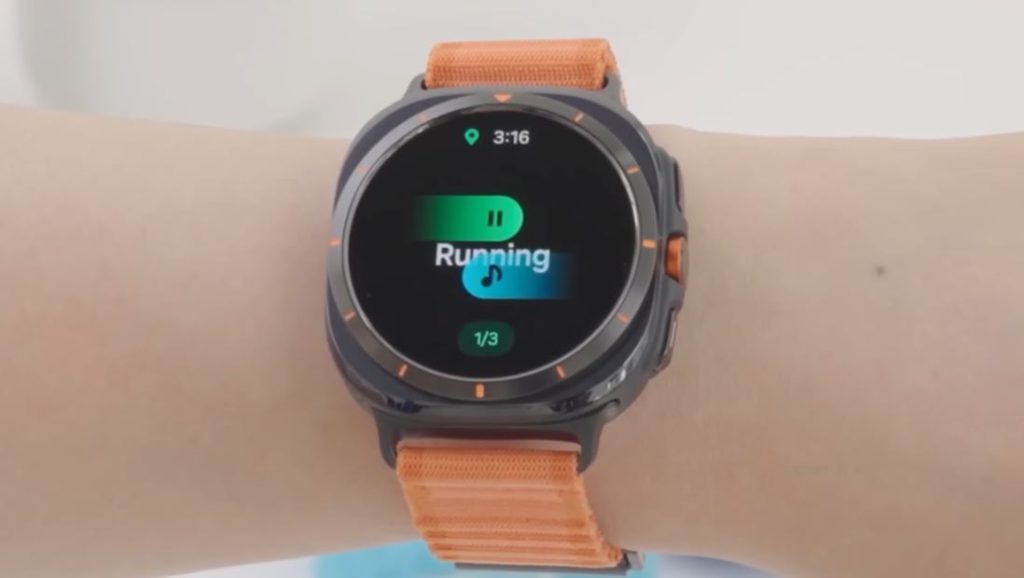
Recently, a certain type of moment has been recurring in electronics stores. Someone taps the screen of a smartwatch, lifts their wrist, and then, almost without thinking, reaches into their pocket for their phone. The Galaxy Watch Ultra 2 5G may be specifically attempting to break that reflex.
According to early leaks and industry rumors, Samsung Electronics‘ upcoming device is more than just a minor update. The more ambitious goal is to make the smartwatch truly self-sufficient. At the core of that promise is full 5G connectivity, which enables calls, streaming, and apps to run without a paired phone. It sounds easy. Seldom is it.
There has always been a conflict between independence and usefulness when observing how smartwatches have changed over the last ten years. Although the original Galaxy Watch Ultra was technically capable but not entirely free, it still felt tethered despite its push toward rugged design and performance. If the rumors are accurate, this new version is attempting to sever that connection entirely.
| Category | Specification Details |
|---|---|
| Brand | Samsung |
| Model Name | Galaxy Watch Ultra 2 5G |
| Release Timeline | Expected Summer 2026 (Geeky Gadgets) |
| Device Type | Premium Smartwatch |
| Operating System | Wear OS (with One UI Watch) |
| Build Material | Likely Titanium chassis (Ultra series standard) |
| Case Size | ~47mm (similar to previous Ultra) (PhoneArena) |
| Display Type | Super AMOLED |
| Display Features | Always-On Display, Multi-touch, Ambient Light Sensor |
| Display Protection | Sapphire Crystal Glass |
| Resolution (Expected) | ~480 × 480 pixels (based on Ultra series) |
| Processor (Chipset) | Qualcomm Snapdragon Wear Elite (3nm) (SamMobile) |
| CPU Architecture | 5-core (1 performance + 4 efficiency cores) |
| GPU Performance | Up to 7× faster graphics |
| AI Engine | Hexagon NPU (on-device AI processing) (Notebookcheck) |
| RAM (Expected) | ~2GB or higher |
| Storage (Expected) | 32GB–64GB |
| Connectivity (Major Highlight) | Full 5G standalone support |
| Other Connectivity | Wi-Fi, Bluetooth 5.3, NFC, GPS |
| SIM Support | eSIM |
| Voice Calling | Yes (standalone via 5G) |
| Messaging & Apps | Fully independent from phone (expected) |
| Battery Type | Lithium-ion |
| Battery Life (Estimated) | Multi-day with optimization; power-saving modes expected |
| Charging | Wireless charging (Qi support expected) |
| Water Resistance | 10 ATM (100 meters) |
| Durability Certifications | IP68 + MIL-STD-810H |
| Dust Resistance | Yes |
| Health Sensors | Heart Rate Monitor, SpO2, Blood Pressure |
| Advanced Health Features | Improved BioActive Sensor, faster tracking |
| Fitness Tracking | Multi-sport tracking, GPS tracking |
| AI Features | On-device AI insights, voice processing, health analytics |
| User Interface | Improved UI with smoother animations |
| Audio Features | Streaming music directly via 5G |
| Navigation | Dual-frequency GPS (expected from Ultra lineup) |
| Build Durability | Extreme conditions (heat, altitude, water) (Samsung sec) |
| Target Users | Athletes, tech enthusiasts, premium smartwatch buyers |
| Key Selling Point | Fully standalone smartwatch with 5G connectivity |
This change may have more to do with behavior than technology. Consumers want fewer devices rather than just faster ones. It’s simple to picture the allure of responding to a message or streaming music straight from the wrist while balancing bags on a packed train. It’s still unclear, though, if that convenience turns into a habit.
The hardware modifications are equally instructive. A Snapdragon Wear Elite chip is mentioned in reports, indicating that Samsung is putting a lot of effort into performance enhancements. Smoother transitions, quicker app launches, and reduced lag are the kinds of features that users don’t always notice consciously but can tell right away when they’re absent. The question of how much speed is really required on something the size of a watch is raised by the fact that the current generation already feels fast enough for most tasks.
Unavoidably, battery life lurks in the background like an unresolved conflict. Although 5G is quick, it requires a lot of power. According to reports, engineers are working on more intelligent energy management, extending usage through software optimization, and perhaps developing new battery designs. There is still some skepticism, though. Anyone who has ever owned a smartwatch is familiar with the routine—charging becomes a regular part of life, sometimes more frequently than anticipated.
It’s difficult to ignore the competitive undertone that exists here as well. Samsung now appears committed to matching or surpassing the benchmark set by the Apple Watch Ultra 3, which has already ventured into 5G territory. These days, perception is more important than features alone. In this segment, it matters to be viewed as first, or at least not second.
This watch has been referred to as a “game changer” in tech circles—a term that is frequently overused. However, it’s simple to understand the source of that optimism when you watch someone run on a treadmill in a gym and look at their wrist rather than their phone. Something is alluring about putting down the phone, even for a short while. Whether it turns into a routine is a different story.
Although not entirely disclosed, the design is anticipated to adhere to the Ultra identity, which is rugged, somewhat oversized, and intended for outdoor use. That consistency has a comforting quality. Samsung appears to be improving what already works rather than completely changing the appearance. That’s sometimes the better course of action.
The way this gadget fits into a larger trend of wearables is intriguing. These days, smartwatches are more than just fitness monitors and alert systems. They are evolving into tiny, constantly active, and increasingly powerful personal hubs. However, that raises the issue of boundaries. When does something that was supposed to make life easier become more complicated?
It’s difficult to ignore users’ slight reluctance when using the internet. Some are eagerly awaiting the release. Some are wary, citing battery issues or doubting the necessity of 5G on a watch. That gap seems significant. It implies that although the audience is still determining what it truly desires, the technology may be ready.
As this develops, it seems that the Galaxy Watch Ultra 2 5G is more than just a new product. It resembles a test more. People’s willingness to trust a watch with tasks they’ve always saved for their phones is being tested. A test to see if habit is more important than convenience.
And perhaps most importantly, a test to see if people will actually use the concept of a fully autonomous smartwatch or merely admire it from a distance before reaching for their pocket phone once more.
