

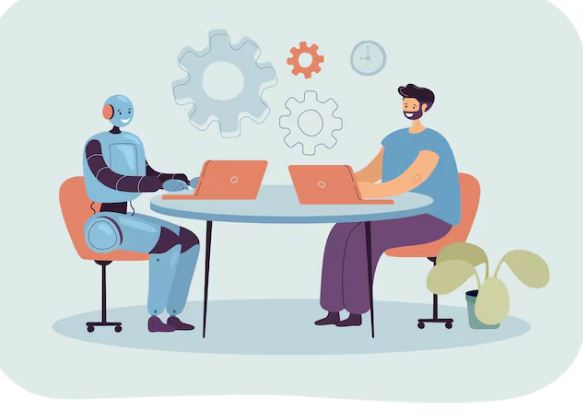
Recently, a small group of engineers experimented on the twelfth floor of a glass office building in San Francisco. They delegated the task of creating weekly financial reports to an AI agent rather than a junior analyst. The agent silently logged into databases, extracted data from spreadsheets, created charts, and wrote a brief synopsis.
The report was completed by lunchtime.
“Well, that’s about three entry-level jobs right there,” an engineer reportedly said, sounding half amused and half nervous as he watched the output scroll across the screen.
These kinds of moments, which are frequently quiet and occasionally experimental, are occurring in offices all over the world. Artificial intelligence is now used for more than just email writing and document summarization. Often referred to as AI agents, a new generation of systems is starting to carry out entire workflows independently.
Although it might sound technical, the distinction is important.
| Category | Information |
|---|---|
| Topic | AI Agents Replacing White-Collar Work |
| Technology | Autonomous AI agents, large language models, automation tools |
| Major Trend | Shift from AI assistants to independent AI “digital coworkers” |
| Most Vulnerable Jobs | Data entry clerks, customer service reps, paralegals, junior analysts, entry-level coders |
| Estimated Risk | Up to 50% of entry-level white-collar jobs exposed to automation within 1–5 years |
| Economic Impact | Companies using AI to reduce hiring and streamline operations |
| Key Companies Using AI Automation | Amazon, Salesforce, Klarna, JPMorgan |
| Emerging Work Model | Humans managing AI systems rather than performing routine tasks |
| Reference Website | Shift from AI assistants to independent AI “digital coworkers.” |
The majority of AI tools have been assistants for the last two years. A chatbot responded to a question you posed. The human was still in charge, even though it could write a memo or recommend code. These days, businesses are experimenting with software that functions more like a coworker than a tool—logging into software platforms, carrying out tasks, sending messages, and completing projects without continual supervision.
The hierarchy in the office seems to be subtly shifting.
The jobs that are most likely to be disrupted are not always the most dramatic ones that people envision. Rather, they are typically the routine positions at the base of corporate hierarchies. Meeting scheduling is done by administrative assistants. clerks who enter data and move numbers between systems. Customer support representatives handling recurring support requests.
These jobs rely on templates, rules, and predictable decisions—exactly the kind of setting where AI excels.
For instance, software agents currently handle a startling portion of support requests in many call centers. They look through internal databases, scan customer messages, and provide responses that seem genuinely human. In certain businesses, AI even handles account resets and refunds automatically, only reporting exceptional circumstances to human employees.
It works well. Too effective, perhaps.
Executives from a variety of sectors are starting to discuss the ramifications more candidly. CEOs have mentioned in passing at recent conferences that corporate teams are getting smaller as AI tools handle routine tasks. The objective, according to one finance executive, is “scrappier teams”—fewer workers doing more with automation operating in the background.
It’s difficult to ignore the change in tone when listening to those discussions. AI was once presented as a productivity tool. These days, it’s frequently talked about as a workforce strategy.
Another illuminating example is found in legal work. In the past, paralegals and junior attorneys would spend long evenings going over paperwork, scanning contracts, and looking for particular clauses buried in thousands of pages. These days, AI tools can complete the same task in a matter of minutes, highlighting pertinent language and summarizing legal risks.
The strategic choices are still made by the senior partners. However, the years of tiresome document work—the traditional training ground—may be diminishing.
A similar shift is being observed in finance departments. These days, AI systems automatically compile investment summaries, run forecasting models, and consume market data. In the past, junior analysts created those spreadsheets by hand, sometimes staying late to complete reports before meetings in the morning.
The software is now the first to arrive at the meeting.
The change is even being felt by the tech sector, which contributed to the development of these tools. GitHub Copilot and other coding assistants started by offering code suggestions. More recent systems are capable of writing complete functions, fixing bugs, and putting together functional prototypes. Products that previously required twice as many developers can occasionally be created by a small team using powerful AI tools.
How far this will go is still unknown.
Some economists contend that rather than completely eliminating labor, automation always modifies it. There are many examples in history. When ATMs were introduced, bank tellers did not disappear. When online booking became popular, travel agents adjusted. Technology frequently eliminates some jobs while establishing new roles related to strategy, oversight, and maintenance.
A similar course could be taken by artificial intelligence.
What some technologists refer to as the “30 percent rule” is being quietly adopted by numerous businesses. AI handles roughly seventy percent of repetitive preparation—data gathering, drafting, calculations—while humans focus on exceptions, judgment calls, and creative decisions.
That sounds like a partnership in theory.
In reality, it might result in an odd labor market. According to some analysts, it is “K-shaped.” Highly qualified experts who are adept at creating, overseeing, and managing networks of AI agents are at the top. Gig workers who handle edge cases that the machines are unable to handle are at the bottom.
The middle could become smaller, particularly in entry-level office positions.
The difference isn’t immediately apparent when strolling through a contemporary office. Laptops are still placed on desks. In the break room, coffee makers continue to hum. For weekly meetings, staff members still shuffle into conference rooms.
However, there is a subtle activity taking place behind the screens.
AI systems are starting to carry out the silent, unseen tasks that formerly trained young professionals, such as creating reports, organizing data, and performing computations. In the past, those chores were necessary but tedious. They were the starting point for careers.
As this develops, a question remains that executives seldom directly address. How do aspiring professionals acquire the skills needed for senior positions if software handles the early-career work?
The workforce might change. Maybe there will be new types of apprenticeships that are more concerned with managing AI than competing with it. Or perhaps completely new occupations will emerge, similar to how earlier technological waves gave rise to unanticipated industries.
However, for the time being, the next generation of AI tools is silently working in offices, finishing spreadsheets, responding to emails, and writing code.
and sometimes completing the task before lunch.
