

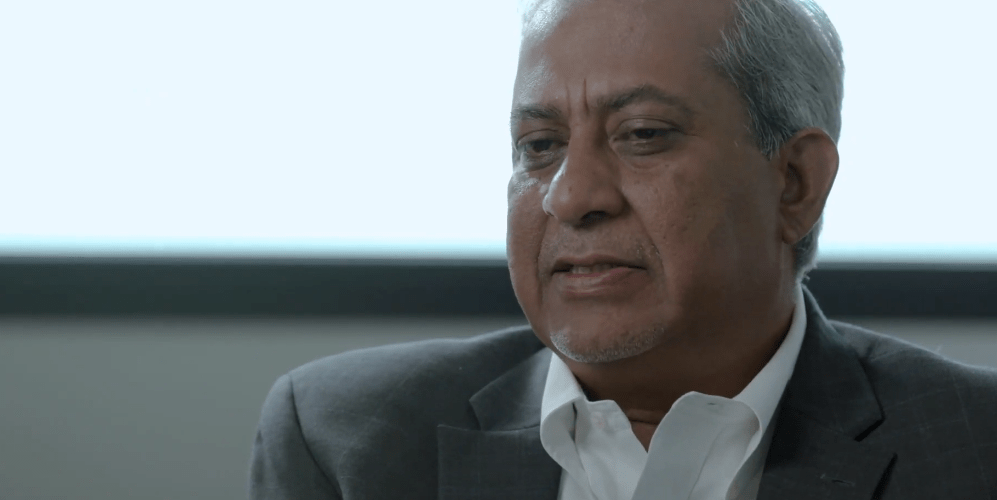
Credit: The Propeller
A serene Midwestern landscape is visible from the corner office of one of his buildings in Rockford, Illinois. Beyond the windows, golf course greens gently roll, and framed pictures of politicians, local authorities, relatives, and moments from decades of public life adorn the walls. It’s an office that feels more like a personal archive than a corporate command center.
This is where Sunil Puri, a real estate developer who came to America with little more than willpower, developed a business career that many observers now believe has resulted in a net worth in the billions of dollars.
| Field | Details |
|---|---|
| Full Name | Sunil Puri |
| Birthplace | Bombay (Mumbai), India |
| Immigration to U.S. | 1979 |
| Profession | Real Estate Developer, Entrepreneur |
| Company | Founder & CEO, First Midwest Group |
| Industry | Commercial Real Estate Development |
| Known For | Transforming properties across Illinois and the Midwest |
| Estimated Net Worth | Often estimated around $1 billion+ (varies by source; not publicly confirmed) |
| Philanthropy | Major donor to Rockford University and local charities |
| Reference | Often estimated at around $1 billion+ (varies by source; not publicly confirmed) |
Although Puri has never disclosed his personal wealth, it is difficult to determine the precise amount, but the size of his projects indicates significant financial success. His business, First Midwest Group, has built commercial properties, hotels, industrial parks, and offices across Illinois and surrounding states over the course of four decades.
His career trajectory starts to resemble a traditional American business tale. However, the first few chapters were anything but cozy. Puri was born in Bombay, India, and immigrated to the US in 1979. He had a high school diploma and roughly $140 when he arrived in the Midwest. The trip wasn’t a part of a well-thought-out business strategy. It was more akin to a religious act.
For a while, the work he discovered had little to do with finance or real estate. He cleaned bedpans in nursing homes. He poured concrete. In order to gradually pay for his education at Rockford University, where he studied accounting, he took any job that came up.
When you hear that story, a certain image comes to mind. A young immigrant is heading to night classes after completing a shift at a nursing home. It’s the kind of information that highlights how difficult it can be to distinguish between opportunity and survival in the early years.
After graduating in 1982, Puri started First Midwest Group, a real estate development business that would eventually become the cornerstone of his wealth two years later.
The initial initiatives were small. Rockford’s expanding business districts were filled with office space, small commercial developments, and local investments. However, real estate has a way of rewarding perseverance, particularly when cities grow.
Puri’s business had developed into a vertically integrated development company by the late 1990s and early 2000s, which meant it did more than just construct real estate. In addition, it invested in long-term ownership, leased them, and managed them.
Owning assets instead of quickly flipping them seems to have been a key tactic. The portfolio subtly increased in value as real estate prices increased over time. Wealth from real estate rarely materializes overnight. It builds up gradually and almost imperceptibly.
However, the scale becomes more apparent when one is outside some of the First Midwest Group-related developments. Former farmland is now covered in office parks. hotels close to highways. commercial hubs with hundreds of employees. There is a physical change. A city’s infrastructure gradually incorporates land that was previously of little economic value.
It’s difficult to ignore the fact that Puri’s business approach appears to have an unusual foundation in community development. He spent decades focusing on northern Illinois and the Midwest, constructing long-term projects in cities that many investors ignore, while other developers concentrate on quick expansion in several markets.
He seemed to perceive opportunity where others perceived stagnation. His public persona was also shaped by that strategy. Puri frequently makes news appearances related to philanthropy and civic engagement, in contrast to some real estate moguls who chase headlines.
He contributed $5 million to the founding of the Puri School of Business at Rockford University in 2012. He has contributed to the funding of community programs, educational initiatives, and regional economic development projects in addition to supporting dozens of nonprofit organizations.
His views on wealth are surprisingly philosophical, based on what he has said in interviews. He has stated that money eventually finds its way back into society.
In a radio interview, he once said, “You’re not taking this money to the moon or to Mars.” “You and the same people are on the same planet.” That perspective illustrates a specific way of thinking that some immigrant business owners have: success entails responsibility.
Naturally, business success is rarely assured indefinitely. The real estate market fluctuates. Cities grow and shrink. Within ten years, economic cycles can turn prosperous developments into struggling ones.
Investors occasionally question whether the upcoming generation of developers will pursue quicker returns in bigger markets or adhere to Puri’s patient, region-focused model.
How the Midwest real estate market will change in the upcoming years is still unknown. However, there’s a reason why Puri’s career trajectory continues to garner attention. He came with virtually nothing and created a business that changed parts of the local business scene.
Even though Sunil Puri’s estimated net worth varies depending on asset valuations, ranging from hundreds of millions to over $1 billion, it almost seems insignificant in comparison to the bigger picture. Because the wealth itself might not be the most striking detail.
It depicts a young immigrant arriving in a foreign nation with a few dollars, working the least glamorous jobs imaginable, and gradually establishing a business empire in locations most people would never think to find one.
There’s a subtle reminder that success doesn’t always begin in venture capital boardrooms or glass towers as you watch that story unfold. Sometimes they start in rural towns where opportunities appear covertly and only reward those who are tenacious enough to pursue them.
