

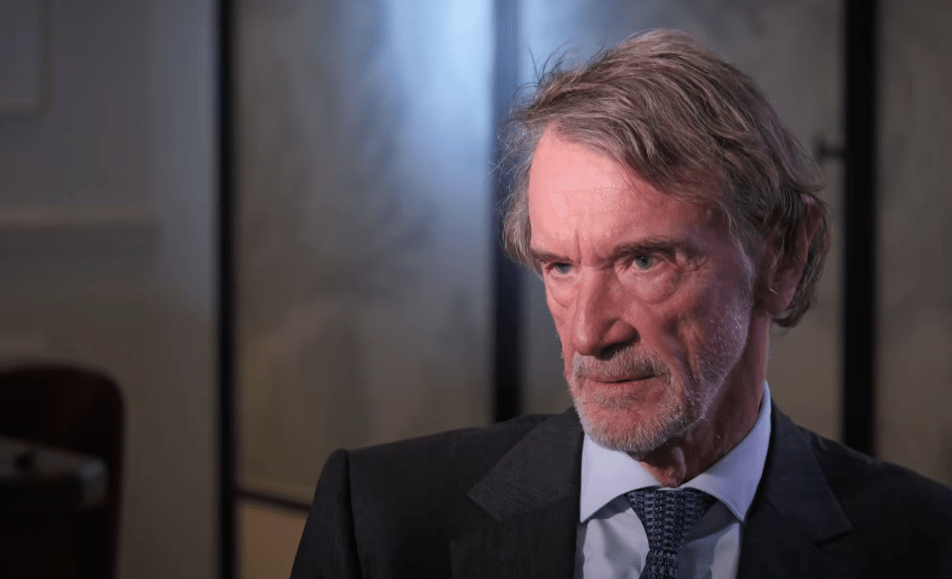
Credit: Sky News
A man who mortgages his house to invest in a failing chemical plant is particularly illuminating.
It indicates that he is placing bets on accuracy, cunning, and bravery in addition to money. Jim Ratcliffe began transforming British industry in the 1990s in this way, long before the media began to follow him like shadows.
| Detail | Information |
|---|---|
| Full Name | Sir James Arthur Ratcliffe |
| Date of Birth | 18 October 1952 |
| Nationality | British |
| Education | BSc Chemical Engineering (University of Birmingham), MBA (London Business School) |
| Occupation | Chairman and CEO of INEOS Group |
| Primary Source of Wealth | Chemicals and Petrochemicals (INEOS) |
| Estimated Net Worth (2026) | $17.5 billion (Forbes), £17.05 billion (Sunday Times Rich List) |
| Major Investments | INEOS Group, Manchester United, INEOS Grenadiers, OGC Nice, INEOS Automotive |
| Tax Residency | Monaco (since 2020) |
| External Reference | Wikipedia: https://en.wikipedia.org/wiki/Jim_Ratcliffe |
Ratcliffe was raised in a working-class family in Failsworth and learned how to calculate risk at a young age. Grit, not glamour, was the foundation of his early years. He observed his mother balancing accounts in an accounting office and his father operating a factory. It didn’t sound like a billionaire’s upbringing. It did, however, imply resiliency.
He stumbled through jobs after studying chemical engineering and later receiving an MBA; BP even fired him after three days. Interestingly, he recovered by focusing on finance and the enigmatic art of negotiating.
He established INEOS by 1998. The company’s blueprint was extremely efficient, but it wasn’t glamorous. Ratcliffe purchased abandoned industrial assets that others deemed outdated. He then made them profitable by aggressively reducing expenses and using debt as leverage.
INEOS expanded with remarkable speed over the ensuing ten years. BP’s former petrochemical arm was one of the crown jewels among the numerous acquisitions that occurred throughout North America and Europe. Every transaction was tactical warfare rather than merely business.
INEOS moved its headquarters to Switzerland in April 2010. The company saved about £100 million in annual taxes just from that action.
Ratcliffe did the same in 2020, moving his personal tax residence to Monaco. He saved an estimated £4 billion as a result of the decision. It brought up moral dilemmas for detractors regarding commitment, responsibility, and public service.
He did not recoil. He hardly ever does.
His wealth reached a peak of nearly £30 billion in 2023. However, it has significantly decreased in 2026, averaging about £17.5 billion. Although still strong, he reflects the challenges of the industry and the intricate relationships between politics, media, and sport that he has entered.
His most audacious public action to date was purchasing a 25% share in Manchester United at the beginning of 2024. It was personal for a fan of boyhood. That was structural for the club.
He not only agreed, but also assumed command of football operations. The executives were moved. Hundreds of employees were fired. The benefit of free meals disappeared. It was calculated, not cruel.
I once paused while going over those staff cuts in a news brief—not out of condemnation, but out of interest. What sort of billionaire plans a £2 billion super stadium next door and cuts stadium stewards’ benefits?
It is what Ratcliffe refers to as “responsible management.” And maybe he does mean it. With a capacity of 100,000, his proposed stadium is marketed as “the Wembley of the North.” If it is successful, it may lead to a regional economic renaissance.
However, controversy still holds sway. In February 2026, he claimed in a televised interview that immigrants had “colonized” the United Kingdom. There was an immediate and loud backlash from unions, politicians, and fan groups.
Later, Ratcliffe expressed regret for his use of language, claiming that it had offended some people. He did, however, maintain the core thesis, which called for “controlled and well-managed” immigration to boost economic expansion.
He has been torn between being a capitalist purist and a philanthropist throughout his career. He’s financing hydrogen projects all over Europe one minute. The next, he’s arguing about emissions with environmental organizations.
He keeps making more and more investments in sports. After purchasing Team Sky Cycling, he changed the name to INEOS Grenadiers. He continues to be a significant sponsor of the Mercedes Formula 1 team and invested millions in America’s Cup sailing.
Although every endeavor seems to be well thought out, not all of them are successful. Some sponsorships came to an early end. Others, such as OGC Nice, might be sold off soon. Even famous athletes like Ben Ainslie have left Ratcliffe’s sphere of influence.
Nevertheless, his trajectory continues to rise. Motivated. facing forward. He recalibrates rather than merely adapts.
Sir Jim Ratcliffe has created more than money through calculated actions, astute judgment, and unwavering ambition. He has leverage.
It’s easy to paint him as contradictory. A Monaco-based Brexit supporter. Green hydrogen is being funded by a billionaire industrialist. A football fanatic cutting spending plans. He might not be conflicted at all, though. Maybe he’s just using the same strategy in wildly disparate contexts: eliminate emotion, pinpoint inefficiencies, and place bets where others are hesitant.
He is not seeking praise. He is seeking results.
And whether Jim Ratcliffe is liked or disliked, one thing is certain: he never simply walks into a room. He is the engineer.
