

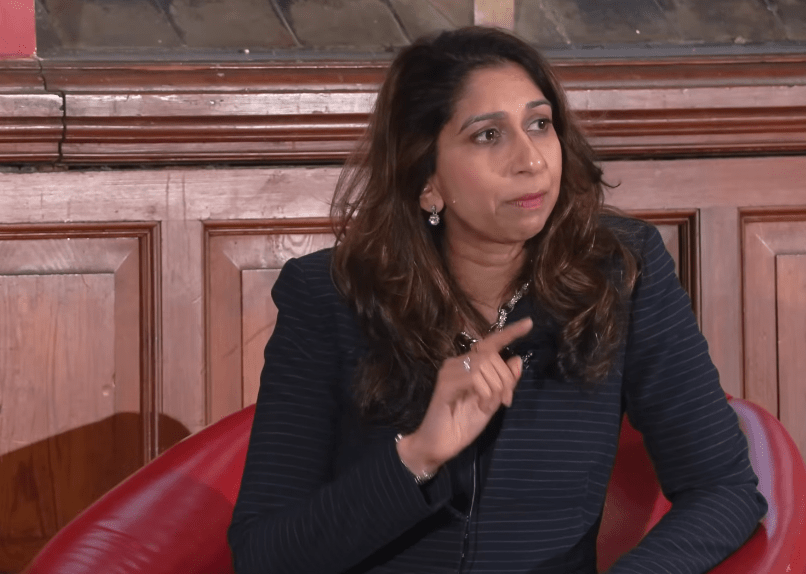
Credit: OxfordUnion
Suella Braverman’s name tends to generate conversations far beyond the halls of Parliament. Her ancestry alone covers three continents; she was born in northwest London to parents with strongly ingrained migration experiences. Her mother, a Tamil from Mauritius, worked in the NHS and dabbled in local politics; her father, of Goan descent, immigrated from Kenya.
For many, such combination might constitute the backbone of a diversity story. But Braverman’s path hasn’t followed predictable arcs. Her relationship to ethnicity, Englishness, and national identity is extremely complex—both personal and political.
| Category | Description |
|---|---|
| Full Name | Sue-Ellen Cassiana Braverman (née Fernandes) |
| Date of Birth | April 3, 1980 |
| Place of Birth | Harrow, London, UK |
| Ethnic Background | Indian descent – Goan Catholic father from Kenya, Tamil Hindu mother from Mauritius |
| Political Career | Former UK Home Secretary; MP for Fareham since 2015; currently aligned with Reform UK |
| Education | Queens’ College, Cambridge and Panthéon-Sorbonne University, Paris |
| Profession | Barrister turned Politician |
| External Reference | https://en.wikipedia.org/wiki/Suella_Braverman |
She went to a private school on a partial scholarship after growing up in a working-class home in Wembley. That early shift—from neighborhood familiarity to elite academic culture—may have quietly altered her ideological compass. By the time she reached Cambridge to study law, she had already begun to formulate beliefs that many would eventually term contentious.
Braverman has long identified herself as a “child of the British Empire,” a statement rich with history and interpretation. For her, it signifies pride. For others, it signals something considerably more contentious. Her family’s history is one of devotion to British institutions, respect for continuity and structure, and faith in the rule of law.
She doesn’t hide from identity—but she doesn’t romanticize it either. While she recognizes being a British Asian, she has made news for declaring she doesn’t consider herself “truly English.” The sentiment surprised even her supporters. It garnered acclaim for its sincerity and condemnation for its implications.
That single comment plucked a thread that unravelled decades of silent discussion surrounding Britishness. Suddenly, being born in London wasn’t enough. Suddenly, ancestral geography seemed to matter more than experienced experience.
I recall reading that phrase and sitting with it longer than usual—it wasn’t just political, it was personal.
Critics perceived the statement as restrictive, an unexpected gatekeeping from someone who had herself passed so many thresholds. Supporters suggested she was only being honest, admitting an unwritten fact about cultural identity in Britain.
The nuance is what makes it linger. Braverman doesn’t reject her ethnicity—she simply reframes it through her own prism of belonging. Her political beliefs align with that perspective. From her two periods as Home Secretary, it was evident she saw immigration not as fundamentally evil, but as something requiring tight, almost moral, regulation.
She has branded multiculturalism a “failed experiment,” a statement that rubs uneasily with many nurtured in its embrace. Yet to her, the problem resides not in variety itself, but in what she regards as a lack of integration. She often divides cultural respect from cultural accommodation, stressing that citizenship must come with integrated principles.
Voters who are worried about changing their identities have found this viewpoint to be incredibly motivating. However, those who aspire to greater inclusion find it especially offensive. The irony is not lost—Braverman’s personal success was built on a platform that now questions how others like her fit into the picture.
Her views on deportation, border control, and the entire concept of asylum have sparked national controversy. The program to deport migrants to Rwanda, for example, became typical of her vision: legally exact, ethically rigorous, and politically contentious.
Nevertheless, she is more than her headlines outside of Westminster. Braverman is a mother of two, married into the Jewish community, and has spoken about the cultural intersections her family now navigates everyday. Her policies are explained by these personal layers, but they do not justify them.
She has a habit of speaking openly, even when the room tenses. It’s harsh, according to her critics. Her supporters call it brave. Regardless, it’s tough to dismiss the impact. She has transformed how British identity is debated—not in abstract terms, but in actual policies.
Timing adds even more complexity to her story. Braverman’s rise occurred when Britain was already wrestling with post-Brexit identity, divided political consensus, and unsolved colonial legacies. She did not create that framework, but she has definitely mastered how to speak within it.
Her political career doesn’t seem to be slowing down now that she is associated with Reform UK. She keeps igniting discussions about nationalism, ethnicity, and what it means to genuinely belong in a society created through migration. Her narrative is both iconic and divisive, remarkably capturing the cultural struggle in Britain.
Braverman may not feel “truly English,” yet her voice has grown vital to the English debate. Whether that’s celebrated or resisted, it’s a reality that demands participation. She hasn’t just walked through the doors her parents thought she might—she’s asking who else deserves a key.
