

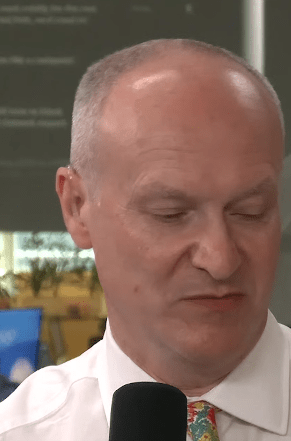
Credit: The Telegraph
Rael Braverman seldom makes an announcement, which is quite comparable to how many people with complex histories decide to progress through public life by making steady contributions while allowing more prominent figures to garner the attention that comes with controversy and power.
Braverman, who was born in South Africa in 1975, was raised in a nation that was still dealing with the fallout from apartheid. This atmosphere subtly taught many of his generation to read social cues carefully and navigate identification with restraint rather than spectacle.
| Name | Rael Braverman |
|---|---|
| Birthplace | South Africa, 1975 |
| Ethnic Heritage | Jewish; family ties to Holocaust survivors |
| Career Highlights | Automotive industry executive; former Reform UK member |
| Spouse | Suella Braverman, UK politician |
| Credible Source | Jewish Chronicle article, Nov 2023 |
As a youngster, he traveled to the United Kingdom, a decision that proved particularly formative, not only in practical terms but emotionally, as movement often sharpens problems of belonging while simultaneously presenting fresh options that feel cautiously won.
His Jewish background is at the center of that story, influenced by family ties to Holocaust survivors, a lineage that carries memory without requiring constant retelling, impacting values via alertness, continuity, and a notably grounded sense of duty.
For many Jewish families with comparable backgrounds, identification serves more as an internal compass than a banner, silently directing choices while remaining remarkably resilient under duress, especially in the face of intense or emotionally charged exterior arguments.
Braverman later resided in Israel, an experience that appears to have enhanced his attachment to Jewish community life while confirming a realistic grasp of security, civic obligation, and the daily realities that rarely fit cleanly into political platitudes.
Professionally, he created a career in the automotive business, eventually holding top posts that demanded extremely efficient decision-making, long-term planning, and the capacity to manage complexity without resorting to dramatic leadership styles.
These characteristics contrast sharply with the political sphere that his wife, Suella Braverman, so obviously occupies, where restraint can be mistaken for weakness rather than discipline and boldness is frequently praised.
When Suella Braverman progressed to top government responsibilities, Rael’s ethnicity became a point of external curiosity, not because he wanted attention, but because closeness to power tends to drag private identities into public perception.
In recent years, especially with heightened tensions surrounding Israel and Gaza, that scrutiny escalated, with observers attempting to map Rael Braverman’s Jewish background onto policy ideas espoused by his wife.
Suella Braverman has spoken frankly, and notably warmly, about her pleasure in her husband’s Jewish background, portraying it as a source of moral clarity rather than political calculation, a distinction that feels particularly essential in contentious moments.
She has also mentioned intimate family links to Israel, including relatives serving in the IDF, details that provide richness to her public pronouncements while reminding audiences that political beliefs can arise from human relationships rather than abstract doctrine.
I remember pausing over one such statement, astonished by how gently it reframed her discourse as something more intimate than strategic.
Rael Braverman himself is conspicuously absent from performative politics, a decision that seems to be incredibly successful in maintaining personal boundaries while also providing support to a partner whose work depends on continuous public exposure.
His brief membership in Reform UK in late 2024 exhibited this balancing, entering without fanfare and quitting without spectacle as internal criticism directed at his wife crossed a line he felt unwilling to accept.
That resignation, occurring quietly months later, revealed a set of objectives centered less in partisan devotion and more in personal integrity, an attitude that feels more rare but particularly valuable in volatile political situations.
Ethnicity, in his instance, works less as a talking topic and more as lived background, impacting reactions to antisemitism, security issues, and cultural memory without demanding center stage or validation through public affirmation.
This understated approach becomes especially significant when addressing Suella Braverman’s controversial claims concerning national identity, ancestry, and who may legitimately claim belonging within Britain’s civic framework.
Her argument that Englishness should be related to bloodline rather than residence prompted significant criticism, prompting predictable concerns about how such logic applies to her own household and to her husband’s migratory journey.
Rael Braverman’s biography complicates those discussions, giving a tale of migration, faith, and integration that transcends basic categorization while remaining profoundly entrenched in British professional and family life.
He pays taxes, raises children in the UK, contributes to industry, and engages civically when necessary, all while carrying a hereditary memory of displacement that makes concerns of belonging feel neither theoretical nor academic.
For observers, this tension underlines a greater truth: ethnicity typically exerts its influence most powerfully when it is not being actively performed, altering instincts, boundaries, and empathy in ways that are not easily defined.
By maintaining a modest profile, Braverman presents an alternate type of public-adjacent existence, one where identification informs action without becoming branding, and where support is delivered continuously rather than publicly.
That constancy looks extraordinarily reliable, particularly during periods of heightened antisemitic worry across Britain, when Jewish households reassess safety, language, and visibility with careful regard to previous patterns.
Rael Braverman’s Jewishness, influenced by survival myths and modern professional life, rests securely in that area, neither concealed nor shown, simply present and quietly determining how he traverses across intricate social terrain.
As issues about identity, migration, and national belonging continue to grow, his story offers an optimistic perspective, showing that integration need not erase memory and that moderation can be unexpectedly convincing.
Rather than dominating discussion, Rael Braverman’s ethnicity operates like a steady river beneath the surface, impacting decisions, relationships, and values while giving room for advancement anchored in lived experience rather than ideological cacophony.
