

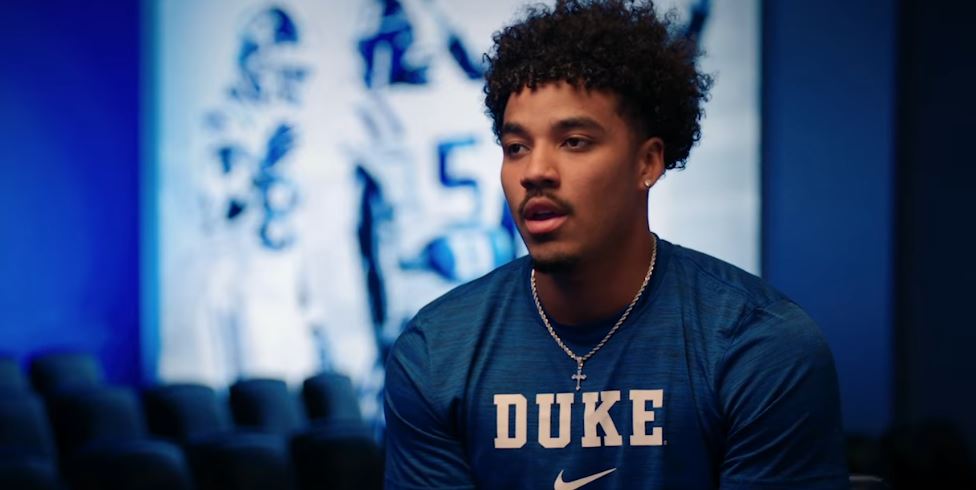
Credit: ESPN College Football
It felt particularly complicated because of the intentional timing. Just hours before the transfer window ended on January 16, Darrian Mensah’s name subtly surfaced in the portal. He had announced his decision to stay at Duke in front of the cameras a month prior. He was getting ready to go now.
Duke University reacted right away with legal documents rather than a press release.
| The case could redefine the enforcement of NIL contracts across college athletics | Darian Mensah |
|---|---|
| Position | Quarterback |
| School | Duke University (2025–2026) |
| Legal Dispute | Facing lawsuit from Duke over alleged NIL contract breach |
| Contract Value | $8 million, 2-year NIL agreement signed July 2025 |
| Legal Implication | Case could redefine enforcement of NIL contracts across college athletics |
| Reference | https://www.yahoo.com/sports/duke-files-lawsuit-over-qb-darian-mensahs-intention-to-transfer-2026.html |
A lawsuit was abruptly brought against their star quarterback, who had guided them to an ACC Championship and had come to represent the program’s recent success. The school asserted that he had violated his two-year, $8 million NIL contract, which secured his off-field brand rights in addition to his on-field presence.
This was not a recruitment issue, according to the university. It had to do with the contract.
Mensah was accused of breaking terms that expressly prohibited him from licensing his name, image, or likeness to another school by trying to transfer. Yes, he could go through the portal. However, the contract stipulated that until the end of 2026, signing or even enrolling at another institution was prohibited.
For a while, the court took Duke’s side. Mensah was prohibited from enrolling in another program, joining another team, or using his NIL in any competing capacity by a restraining order granted by a judge. Until a hearing on February 2nd, the order is in effect.
There is more going on here than just a disagreement between a university and an athlete. It serves as a barometer for the extent to which NIL agreements can influence a player’s professional path.
NIL has drastically transformed collegiate athletics over the last three years, opening up previously unheard-of possibilities for athletes to receive payment for their impact. However, compensation entails structure, and structure entails legal responsibility.
The earning potential is exceptional for players like Mensah, who transferred from Tulane to Duke in 2025 following a standout season. However, it is linked to ever-more complex contracts. And everything stops when those contracts are contested, as this one has been.
The clause Duke is standing on explicitly states that any violation causes “irreparable harm,” according to court documents. If this threshold is upheld, it justifies both monetary recovery and injunctive relief. This implies that Mensah might not only owe money, but he might also be prohibited from performing anywhere else until the matter is settled.
The legal team for Mensah has a different perspective. They contend that NIL contracts cannot be used to limit an athlete’s mobility like a corporate non-compete because they do not create employees. The main idea is this: how can a school prevent athletes from switching teams if they aren’t compensated to play?
The court’s interpretation of NIL exclusivity in relation to educational institutions will probably determine the answer. The terrain is challenging.
Players had more freedom, quicker transfers, and improved visibility during the pandemic than ever before. However, the NIL era has partially undone that, entangling athletes in intricate contracts that resemble professional sports endorsements. In reality, these agreements are legally binding, enforceable, and potentially career-defining, as Mensah’s case now illustrates.
It was not only the lawsuit’s legal rigor that caught my attention, but also how quickly trust broke down.
After Duke won the Sun Bowl, I recall watching Mensah’s postgame interview. “I wouldn’t want to do this with anyone else,” he said, putting an arm around his receiver and complimenting the coaching staff. There was nothing performative about his tone. It had a sense of stability. Sincere.
However, less than a month later, speculation about a potential relocation to Miami—a program said to have provided an alluring package—started to circulate. Notably, Miami had its own history: they had previously dismissed Manny Diaz, the current head coach at Duke. A new legal dispute was given a layer of old rivalry by the emotional undertones.
Mensah didn’t technically break any NCAA rules by using the portal. Duke contends, however, that he broke a legally binding agreement by trying to enroll in another school. Despite its apparent narrowness, the distinction serves as the case’s cornerstone.
This situation is attracting attention from coaches, athletic departments, and legal advisors for one obvious reason: it highlights the continued fragility of these NIL relationships. Even if a player has a contract, what prevents another school from making a better offer?
There is currently no reliable response to that question for early-stage NIL programs.
Notably, other programs have already attempted to use the legal system to enforce NIL deals. A defensive back was sued by Wisconsin. After transferring, Georgia said a lineman owed them money. However, none of those featured a quarterback with Mensah’s level of skill or wealth.
This story feels so defining because of this. It goes beyond a player switching schools. With millions behind him, the quarterback is attempting to determine whether a college contract can truly keep him committed.
There are still a number of possible outcomes as the hearing in February draws near. Mensah might bargain for a takeover. Under new conditions, he might go back to Duke. He could wait for the contract to expire. Every route has repercussions for him as well as for onlookers.
Schools nationwide might feel more confident to bolster NIL enforcement if the court finds in Duke’s favor. Players may feel much freer to pursue new opportunities without worrying about legal action if Mensah prevails.
Both sides are holding their ground for the time being. The judge will make a decision shortly.
Regardless of the result, however, the case is already having a significant impact. Fundamentally, it is about taking responsibility for one’s future, one’s brand, and the commitments made in a system that is changing quickly.
Mensah’s case might be remembered as a symbol of change rather than merely a legal dispute as collegiate athletics strives for a new balance.
