

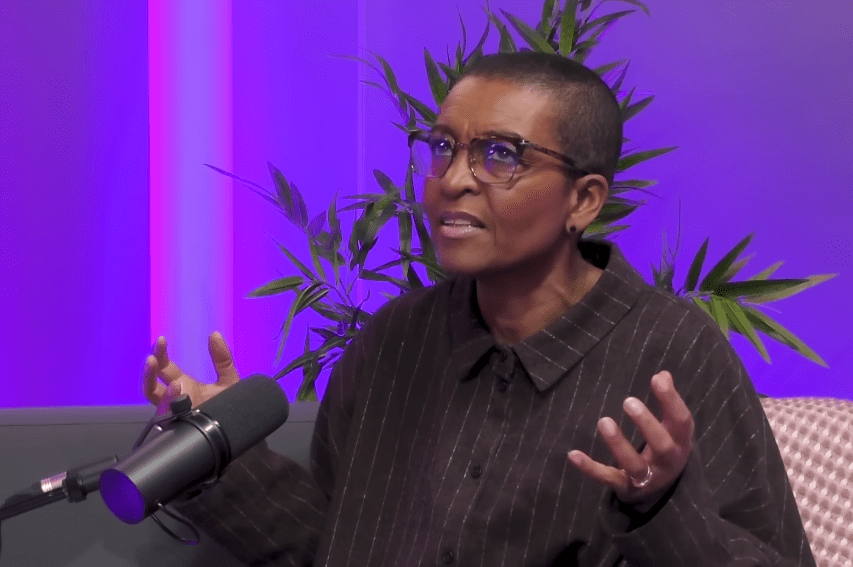
Credit: BBC World Service
Raised in the tranquil hills of Gloucestershire, Adjoa Andoh was a stunning presence long before she graced any stage. The daughter of an upper-class Ghanaian father and a white English mother, she was often the only Black or mixed-race child in sight—noticed immediately, but rarely completely seen.
She’s described her youth as a blend of rich culture and dramatic contrasts, where a strong Yorkshire accent collided with conservative expectations in rural Cotswold towns. Her father, formerly admired in Ghana, was swiftly subjected to the British system’s contemptuous gaze. He mentored staff members who went on to become his supervisors, despite being overqualified and frequently ignored.
| Name | Adjoa Andoh |
|---|---|
| Date of Birth | January 14, 1963 |
| Place of Birth | Clifton, Bristol, England |
| Ethnicity | Ghanaian father (Akan), English mother |
| Known For | Bridgerton, Doctor Who, Invictus, RSC theatre |
| Awards & Honors | MBE, Royal Society of Literature Fellow, NAACP nominee |
| Activism | Fairtrade ambassador, LGBTQ+ advocate, anti-racism educator |
| Reference | https://en.wikipedia.org/wiki/Adjoa_Andoh |
The paradox of excellence being overlooked reverberated throughout the family. Her mother, driven out by relatives for marrying a Black man, never looked back. Together, they made the decision to be resilient, even if it meant being alone.
As a girl, Adjoa understood early how profoundly difference might wound. She recalls being physically abused in school, her head pounded against hard Cotswold stone walls, simply for existing in a space that didn’t expect her. There’s something heartbreakingly specific about her memories of offering chocolate to classmates, hoping it may cushion blows she didn’t yet understand.
By her teens, she was wearing safety pins and black eyeliner—adopting punk not just as a style, but as armor. In small places where acceptance felt conditional, punk offered something surprisingly comforting: it expected you to be out of place.
Her ethnicity was a daily test of visibility and belonging, not just a characteristic. But rather than erasing her, that tension made her more lucid.
She quit law school after two years, moving toward acting with a decisiveness that seems, in hindsight, inevitable. Her entry into theatre was not ceremonial—it was basic. From early work at the Royal Court to directing Richard II with an all-women-of-color cast, Andoh has been continuously pushing the stage to extend what it reflects.
By deciding not to wait for inclusion, she erected frameworks around her own voice. Her career indicates a constant pattern—highlighting narratives that have been neglected, restructuring settings to be more representative and equal.
She is, by all standards, a working actor—narrating audiobooks, directing community theatre, voicing characters in video games, and popping up on network TV. Her resume is very diverse because she never boxed herself into one concept of success.
I remember watching her talk on a tiny audio documentary panel, where she explored reading Americanah aloud for radio. Her tone was restrained, but the care in her pronunciation made me note how storytelling, for her, was very personal, not performative.
Her individuality pours into her work—never loudly, but consciously. When she described the coronation for ITV and noted that the royal balcony looked “terribly white,” she received a record number of complaints. Yet her response remained anchored. She wasn’t recanting. She was clarifying. She clarified that the remark was based on contrast rather than condemnation. Andoh had only observed a change that was both socially and visually obvious.
She doesn’t speak with resentment. She speaks from experience. One of her most effective techniques is that tone, which is measured but unwavering. It allows her to occupy locations that often resist change and gently nudge them toward it regardless.
Through strategic alliances and constant campaigning, Andoh has dramatically enhanced representation on- and off-screen. Her portrayal of Lady Danbury in Bridgerton afforded young viewers—particularly youngsters of color—a rare sight: regality without apology.
She still receives images from tiny girls dressed in Regency robes, looking up at her not just as a character, but as a symbol of promise. Some even dress like Lady Danbury herself—an older woman, aristocratic and sharp-tongued. That’s representation doing its deeper, lengthier work.
By merging legacy, memory, and lived experience, Andoh has produced a voice that’s both highly efficient and incredibly effective in confronting institutions from inside. She regularly selects initiatives that combine art and purpose, whether it’s a Christmas advertising campaign or the Booker Prize jury.
She has helped other authors through the Future Worlds Prize, an effort for science fiction authors of color, and directed new plays in recent years. It’s not just about her rising—it’s about extending the route.
Her story is not one of arrival but of continual architecture. Identity for Andoh is not permanent or decorative—it’s useful. It carries weight. And it supports.
That’s what makes her so compelling—not just as an actress, but as a designer of better storytelling. She’s developing something very durable. And she’s doing it so others can stand on it too.
