

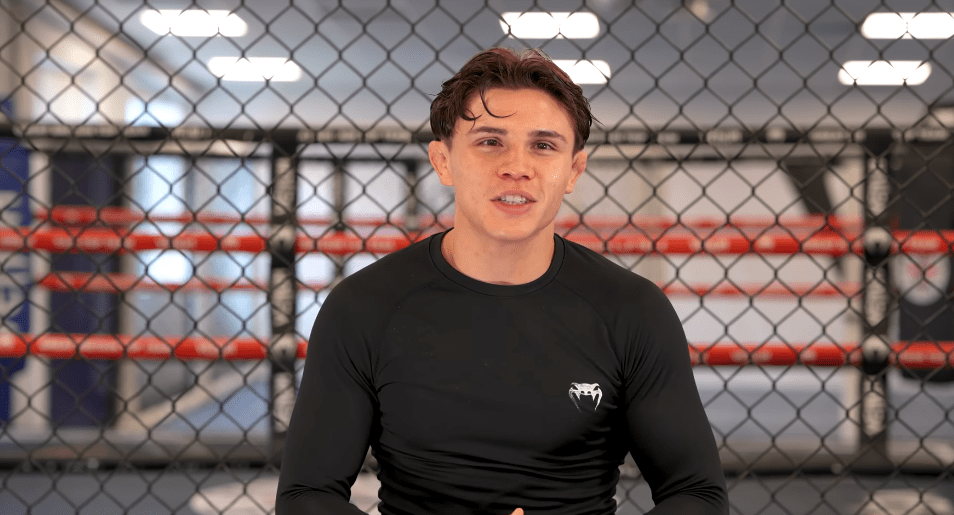
Credit: Fitshop Greece
The air in a London training gym smells slightly of sweat, leather, and disinfectant on most evenings. Fighters silently wrap their hands while precisely tapping heavy bags or skipping rope. Lone’er Kavanagh has been building a reputation that feels a little different from the average UFC prospect in that setting, which is equal parts chaos and discipline. His name is where some of that distinction starts.
Pronounced roughly as “Lon-er,” “Lone’er” is not a common British name. It contains a subtle narrative that is closely related to Lone’er Kavanagh’s ethnic background, which is a mix of Chinese and Irish ancestry that represents both sides of his family’s past. His father, Irish, passed away when Kavanagh was still a child. Raised in London by his Chinese mother, he was first exposed to martial arts at the age of eight.
| Category | Details |
|---|---|
| Full Name | Lone’er Kavanagh |
| Date of Birth | June 9, 1999 |
| Birthplace | London, England |
| Nationality | British |
| Ethnicity | Mixed Irish and Chinese heritage |
| Profession | Professional Mixed Martial Artist (UFC Flyweight) |
| Team | Great Britain Top Team |
| Education | Degree in Sports Science |
| Notable Achievement | UFC Performance of the Night vs. Brandon Moreno (2026) |
| Reference | https://www.ufc.com |
That background has a subtle symbolic meaning. Chinese martial arts are based on balance and discipline, while Irish culture is known for its tenacious tenacity. Part of Kavanagh’s fighting personality—aggressive but controlled, explosive but thoughtful—may be explained by that combination.
According to reports, his name “Lone’er” means “little dragon” in Chinese. It’s difficult to ignore how oddly fitting that nickname seems when you watch him move inside the octagon. Sharp bursts of speed, quick footwork, and unexpected strikes are common components of his fighting style. However, heritage by itself does not make a fighter.
Kavanagh grew up in the multicultural setting that characterises London. You can hear a dozen different languages while strolling through areas like Camden or Hackney before you’ve finished your coffee. It’s the kind of place where identity is dynamic rather than static.
Kavanagh’s early years were similar to those of many athletes: training after school. When he was younger, his mother reportedly encouraged him to try kickboxing, possibly thinking that combat sports would be a good way to channel his restless energy. Almost instantly, something clicked.
By the time he was a teenager, he was competing on a regular basis and had become familiar with the rhythm of fights, including the tense silence that precedes a bell ringing and the rush of adrenaline that follows a perfect shot. Coaches noticed his innate ability to strike, which would eventually turn into his most lethal weapon.
It’s difficult to ignore the complex personal histories of many successful fighters. Early difficulties, family sacrifices, and mixed cultural backgrounds. These encounters can sometimes result in a mental toughness that is difficult to teach.
In Kavanagh’s case, the early death of his father appears to have had an impact. Although fighters seldom discuss those experiences in-depth, those who are close to him frequently mention a feeling of quiet resolve. Not blustery arrogance. Something more concentrated.
Kavanagh had already established a solid striking foundation by the time he joined the professional mixed martial arts scene in 2019. His early fights showed a fighter comfortable in chaos—landing knockouts, pressing forward, and adapting quickly.
He had the opportunity to demonstrate his abilities through promotions like Cage Warriors, a renowned European stepping stone to the UFC. The competition is rarely forgiving because that league has produced fighters like Paddy Pimblett and Conor McGregor.
He was allowed to compete in Dana White’s Contender Series in 2024, which is a testing ground for potential UFC contracts. These gatherings frequently resemble cage-based job interviews because fighters are aware that one outstanding moment could alter their entire career.
He won a UFC contract and became well-known in the flyweight division after knocking out his opponent in the first round. In British MMA circles, the event felt less like a surprise and more like confirmation of long-held suspicions.
However, setbacks are a common part of UFC success. Fans were reminded of the harshness of the sport when Kavanagh lost his first professional fight in 2025 via knockout. Fighters’ reactions to defeats frequently reveal more about them than their wins.
In early 2026, Kavanagh made a comeback and agreed to a short-notice bout against former champion Brandon Moreno in Mexico City. He performed calmly against an experienced opponent and a boisterous crowd, winning by unanimous decision and receiving a Performance of the Night bonus.
There’s a growing sense within MMA circles that the flyweight division is entering a new era. The rankings are still dominated by veterans, but younger fighters—many of whom come from a variety of international backgrounds—are starting to rise quickly. Kavanagh is a perfect fit for that trend.
His Irish-Chinese ancestry, British upbringing, and international fighting career reflect the evolution of mixed martial arts. Once dominated by fighters from a small number of nations, the sport now attracts talent from all over the world.
It is clear how global Kavanagh is when you walk through a gym like Great Britain Top Team, where he trains. Between sparring sessions, fighters from Brazil, Eastern Europe, Africa, and Asia exchange techniques and anecdotes while sharing mats. In that setting, heritage becomes more about influence than labels.
It seems as though Kavanagh’s upbringing subtly influences his style of training. His willingness to persevere through demanding sessions is an example of Irish grit. Chinese discipline is evident in the exact manner in which he repeatedly practices combinations. It’s still unclear if he will ever win a UFC title. Combat sports seldom have set plots.
However, something is fascinating about his tale. A fighter named “Little Dragon,” born in London, carries Irish and Chinese roots into the world’s most intense fighting stage. Identity can sometimes influence more than just a person’s past. Occasionally, it influences their fighting style.
