

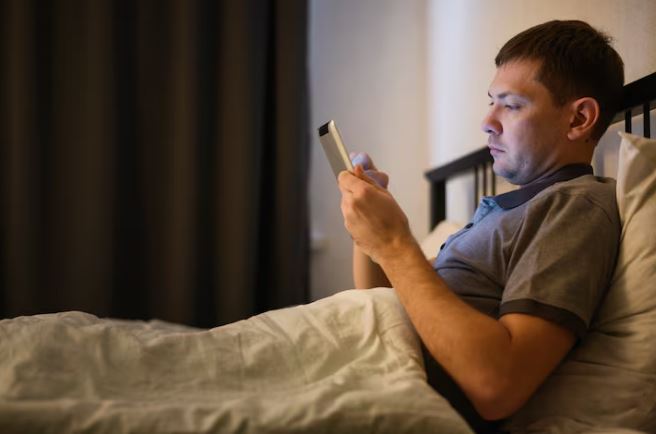
At eleven o’clock at night, you’ll see the same scene in any university library: students bent over laptops and textbooks, many of them with phones lit next to them, notifications coming in in tiny, persistent pulses. Technically, they are studying. Additionally, likely, they’re not getting enough sleep. Not nearly enough. This isn’t a tale of sporadic late nights before tests. It tells the tale of a long-term, widespread disruption to a basic human need like food or water, as well as a gadget that has subtly emerged as the main cause of this disruption.
The data, which has been gathered over the past ten years from studies conducted on several continents, is unsettling and consistent. In a large UK study of young adults, 38.9 percent showed signs of smartphone addiction and 61.6 percent reported poor sleep quality. The two issues tracked together in ways that ruled out coincidence. According to a systematic review and meta-analysis of 16 studies involving over 9,000 medical students, 39% of them fit the criteria for smartphone addiction, and 57% of them had poor sleep. The researchers found a clinically significant correlation between the two. The average amount of sleep that the students were getting was 5.62 hours per night, which is much less than the 7 to 9 hours that adults need for the kinds of cellular repair, memory consolidation, and immune function that sleep is intended to carry out. These are not students who don’t want to go to bed. These individuals carry a device with them everywhere they go, including to bed, which is working against their physiology.
| Topic | Smartphones and Sleep Loss: The Silent Epidemic Among Young Adults |
| Prevalence | 61.6% of young adults in a large UK study reported poor sleep quality; 38.9% showed signs of smartphone addiction; 57% of medical students across 16 studies (9,466 participants) had poor sleep; 71% of university students in UAE reported poor sleep quality (ScienceDirect 2023) |
| Key Risk Factor | Using a smartphone in bed for more than 60 minutes increases the risk of poor sleep quality by over seven-fold; medical students use smartphones an average of 4.9 hours daily, primarily for social media and messaging |
| Biological Mechanism | Short-wavelength blue light from screens suppresses melatonin production, disrupting circadian rhythms and delaying sleep onset; LED/screen light mimics daylight signals, preventing the physiological transition to sleep mode |
| Psychological Mechanisms | Cognitive/emotional arousal from social media and gaming; “bedtime procrastination” — choosing phone activity over sleep; FOMO-driven late-night interaction; bidirectional relationship (sleep loss increases phone use to pass time, which worsens sleep further) |
| Health Consequences | Impaired memory consolidation and academic performance; increased anxiety, depression, and loneliness; weakened immune function; obesity risk (hormone dysregulation); cardiovascular strain from chronic sleep deprivation |
| Reference | PMC — The Relationship Between Smartphone Addiction and Sleep Among Medical Students (pmc.ncbi.nlm.nih.gov) |
This is a specific and well-understood biological phenomenon. Short-wavelength blue light, which the brain perceives as daylight, is emitted by smartphones. The pineal gland is instructed to reduce melatonin production when light strikes the retina in the hours preceding sleep. The hormone that starts sleep is called melatonin. The body’s internal clock is pushed forward when its production is suppressed; this is known as the delayed sleep phase. In clinical terms, this means that the person cannot fall asleep until later, and the total amount of sleep time compresses when a fixed wake-up time is imposed by work or lectures the following morning. The biological mechanism is this. Everybody who reads their phone in bed is conducting this experiment on themselves, and the majority of them are unaware that the outcome is predictable.
However, even though the blue light explanation is true, it only partially explains the issue. What’s going on emotionally and cognitively during that phone use before bed might be the bigger problem. Social media use results in a particular type of mental activation that is nearly the opposite of the calm, slowing mental state that comes before sound sleep, such as comparison, emotional response, and social monitoring. Arousal is produced by gaming. It takes a long time for the stress response to subside when you check your email or study-related messages at 10:30 at night. When the phone is placed face-down on the nightstand, the brain’s threat detection systems, activated by an anxious notification or an unsettling feed scroll, do not instantly stand down. Additionally, a lot of young adults never turn their phones face down. Its screen periodically illuminates the room throughout the night while it charges on the pillow next to them and is programmed to vibrate.
Researchers have found a particularly vicious cycle in the relationship between smartphone use and sleep disturbance: each exacerbates the other. People who are sleep deprived are more likely to reach for their phones in the middle of the night and during the day because they offer social interaction when loneliness is increased and stimulation when the brain is too tired to focus. The next night’s sleep is made worse by phone use, which exacerbates the weariness and leads to an increase in phone dependence. Although it may be an understatement, calling this bidirectional is technically correct. Every cycle pulls the person farther away from functional rest, making it more of a drain.
The effects go far beyond fatigue. Memory consolidation, the process by which knowledge acquired during the day is transferred to long-term storage during sleep, is hampered by inadequate sleep. This is a real issue for college students because it has an immediate impact on their academic achievement. Long-term sleep deprivation weakens the immune system, dysregulates the hormones that control hunger and metabolism, increasing the risk of obesity even in young adults, and has been linked to anxiety and depression, conditions that are already common in a population under a lot of social and academic pressure. Research has focused on the mental health aspect in particular. Studies have found positive correlations between smartphone addiction scores and measures of loneliness, anxiety, and depression, painting a picture of poor sleep as both a symptom and an amplifier of more general psychological distress.
It’s difficult to ignore the fact that this situation has been known for years, and that not much has changed in terms of how smartphones are made or how their use in bedrooms is viewed. Most devices have “night mode” settings that filter some blue light but have no effect on cognitive arousal. According to the research, they are far less effective than just taking the device out of the room. However, taking the gadget out of the room necessitates using an analog alarm clock, which the majority of young adults haven’t had since they were kids, and embracing a distance between themselves and their alerts that the attention economy opposes. Technically, the solutions are straightforward. It’s quite another to get people to use them in a setting that’s meant to keep them connected.
