

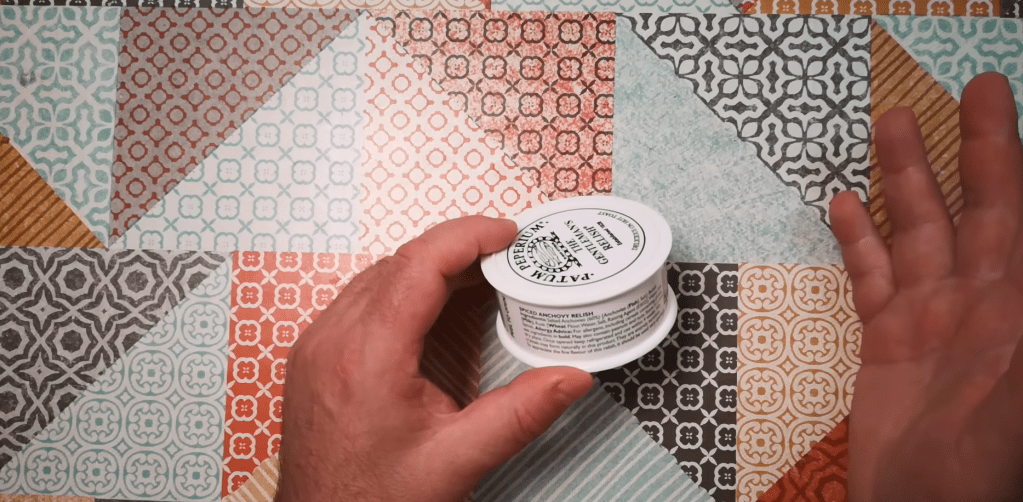
The loss of food is associated with a specific type of grief. Something in the same neighborhood, but not quite grief—that word belongs to bigger things. A low-key lament over something that was always there, in its little white ceramic pot with the blue lettering, on the shelf, and is now abruptly gone. When AB World Foods revealed this week that Gentleman’s Relish, the strong anchovy spread that has been a staple of British cuisine since 1828, had been discreetly discontinued, it affected a certain part of the country. Earlier this year, production ceased. The last pots are the ones that are still on the shelves. There won’t be any more.
John Osborn, an English grocery store owner in Paris, invented the condiment by combining anchovy fillets, butter, rusk, and a variety of herbs and spices. He either never recorded the mixture for anyone else or, if he did, it has not survived in any useful form. At launch, he dubbed it Patum Peperium, which is mock-Latin for pepper paste, and made the audacious claim that it was a quintessential English delicacy for something that had been invented in France.
| Category | Details |
|---|---|
| Product Name | Gentleman’s Relish (also known as Patum Peperium) |
| Created | 1828 by John Osborn, an English grocer living in Paris |
| Publicly Launched | 1849, Paris Food Show |
| Age at Discontinuation | Approximately 177 years |
| Manufacturer | AB World Foods |
| Reason for Discontinuation | Diminished sales; unable to secure a buyer for the brand |
| Main Ingredient | Approximately 60% anchovies, combined with butter, herbs, and spices |
| Recipe Status | Always kept secret |
| Notable Fans | Nigella Lawson, Ian Fleming |
| Still Available From | Simpson’s in the Strand (£6.50); Fortnum & Mason own version (£14.95) |
| Simpson’s Chef | Jeremy King (restaurateur) adapted a classic Victorian recipe |
| Production Location (Final Years) | Poland (after AB World Foods moved production) |
| Reference Website | The Guardian – Gentleman’s Relish |
When it debuted at the Paris Food Show in 1849, it had discovered its target market: a specific type of Briton who enjoyed robust flavors, anchovies on toast, and the subdued satisfaction of eating something that most others found excessive. After almost 200 years of production, ownership changes, and ultimately the relocation of manufacturing operations to Poland, the recipe remained a secret. Nobody outside of AB World Foods knew exactly what went into it, even at the end.
The response to the Gentleman’s Relish story, which was discontinued, suggests that the product had a greater impact on consumers than its sales numbers suggested. This is frequently the case with foods that occupy a niche: they are fiercely adored by a select few, unknown or actively despised by everyone else, and financially unviable in a way that has nothing to do with the product’s quality. AB World Foods was straightforward: there was no buyer for the brand, retailer distribution had decreased, and the relish’s commercial appeal had diminished. In a time when shelf space is competitive, and supermarkets make decisions based on velocity rather than tradition, it’s a familiar conclusion for heritage food products.
It’s not going unnoticed by the fans. Reactions on social media have ranged from sadness to genuine outrage; some have called the decision “utterly heartbreaking,” while others have demanded that AB World Foods reveal the secret recipe before it is completely lost. Michelin-starred chefs have voiced their opinions, claiming that since the formula is no longer commercially protected by active production, it should be preserved or, at the very least, put into the public domain.
Pressure might result in a licensing agreement, a craft manufacturer taking up the mantle, or some sort of continuity. It’s also possible that the original Gentleman’s Relish becomes one of those things that people describe to younger generations with a certain kind of wistful authority, and the recipe just ends up in a drawer somewhere.
The fact that Simpson’s in the Strand continues to serve is almost fitting. Last month, restaurateur Jeremy King reopened the 198-year-old London eatery, which is roughly the same age as the relish itself. King has discreetly given his chef instructions to create a version that closely resembles the original Victorian recipe. King, who has overseen the Ivy, Wolseley, and Le Caprice over the years, told the Guardian that his chef had discovered and modified a traditional patum peperium recipe, and that some patrons had come in and placed orders while crying. Depending on how you feel about condiments made with anchovies, that detail may be either incredibly moving or subtly ridiculous, but either way, it conveys a truth about what happens to people when food has enough history.
Once listing Gentleman’s Relish as one of the ten foods she could not live without, Nigella Lawson said she would now have to settle for a homemade version made with butter and anchovies. For those who enjoyed the product, that’s actually a reasonable solution—it was never a complicated formula, just a precise one—and the discontinuation may encourage a generation of home cooks to make their own, which is, in some ways, a more intriguing result than the spread merely continuing to sell in small quantities until the next corporate review. For their part, Fortnum & Mason still sells their own version, which includes anchovies, dill, garlic, and Sarawak pepper, for £14.95 per pot.
Looking at the entire plot, it’s difficult to ignore the fact that Gentleman’s Relish withstood two world wars, the fall of the British Empire, and a radical change in the country’s diet before being brought to an end by declining supermarket distribution and a failing balance sheet. For something so wonderfully extraordinary, that is a boring conclusion. A fan was Ian Fleming. It was carried in the luggage of Victorian explorers. And now it’s gone, leaving behind a tiny white pot, a secret recipe, and a lingering anchovy smell that is either overdue or devastating, depending on who you ask.
