

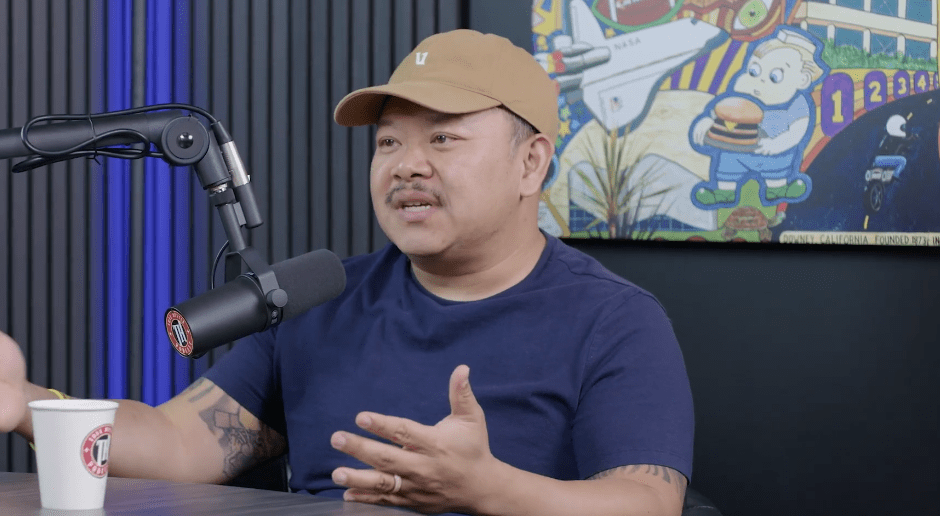
Credit: True Hustle Podcast
Imagine the situation. You’ve done everything correctly. After purchasing your ticket, you checked in, navigated the terminal, got through the boarding line, located your row, put your bag away, and took a seat. The doors are almost closed, the plane is packed, and you are, by any reasonable definition, finished. The difficult part is done. Then someone tells you you’re in their seat after walking down the aisle and glancing at you.
On a recent domestic flight, Minh Nguyen, a digital creator and frequent traveler on American Airlines, experienced that. His Facebook post detailing the incident received over 850 reactions in a single day, igniting a discussion that has since spread throughout aviation and social media in general. It is worthwhile to carefully read the details as Nguyen described them. He was on the plane. He was seated. He was followed by a standby passenger who pointed to his seat and claimed it as her own.
| Category | Details |
|---|---|
| Person Involved | Minh Nguyen (Digital Creator) |
| Airline | American Airlines |
| Incident Type | Post-boarding seat removal in favor of a standby passenger |
| Passenger Status | Top-tier American Airlines frequent flyer |
| Platform Where Story Went Viral | |
| Reactions on Post | 850+ reactions within 24 hours |
| Nguyen’s Description | Called the incident “super rude.” |
| American Airlines Response | No public comment at the time of reporting |
| Relevant Policy | US compensation rules apply to pre-boarding denials; post-boarding rules remain ambiguous |
| Industry Practice | Airlines routinely overbook to offset no-show rates |
| Reference Website | Simple Flying – Airline News |
When Nguyen presented the flight attendant with his boarding pass, which served as tangible evidence that the seat belonged to him, the crew member examined it, checked an iPad, and informed him that his name was not on the check-in list. One thing was stated on his boarding pass. Another was said by the system. Apparently, the system prevailed.
Any frequent traveler can relate to the Minh Nguyen airline seat issue because it touches on the feeling that the confirmation in your hand doesn’t mean as much as you think it does. For a long time, airlines have operated under the presumption that passengers are aware that overbooking is a normal aspect of commercial travel. Despite their reluctance, the majority of people have internalized this. The timing of Nguyen’s case feels different. Although it’s annoying, being bumped before you board has a predictable pattern. It’s quite another to be taken out of a seat you’re already occupying, with your bags already raised. The majority of passengers were unaware that it crossed a line.
In the airline ecosystem, standby passengers hold a unique position. They are accommodated according to availability, status, fare class, and occasionally operational necessity; the precise weighting of these factors varies by airline and isn’t always made clear to anyone, including the gate agents in charge of them. According to standard procedure, standby assignments are completed prior to the boarding door closing in order to prevent the kind of altercation that reportedly occurred on Nguyen’s flight. When that procedure fails, a crew member must make a call in real time in a small aisle while a crowded aircraft watches a standby passenger arrive at a full seat. The airline’s own protocols are meant to avoid this uncomfortable circumstance.
Regarding the particular incident, American Airlines has not made any public remarks. That quiet is noteworthy, if not shocking. Airlines prefer to handle individual passenger complaints through customer service channels, where the discussion remains private, rather than addressing them in public statements. Nguyen might have been directly compensated or explained. Additionally, there may be less formal obligation to respond than people might think due to the ambiguity of post-boarding removal policies, which are actually less clearly defined under US passenger rights regulations than pre-boarding denials.
People are often surprised by this aspect of airline passenger rights. The United States has fairly well-established regulations regarding involuntary denied boarding, including rebooking requirements and compensation thresholds. However, the majority of those safeguards are built around the gate rather than the cabin. The legal environment becomes more hazy once you’re seated, and airlines have a great deal of latitude in how they respond to operational disruptions. Nguyen found himself in that gray area, standing in the aisle with a boarding pass proving he was correct and a crew member essentially telling him it didn’t matter.
Seeing incidents like this build up on social media gives the impression that the airline-passenger relationship has changed. The most extreme version of this story is still United’s 2017 forcible removal of a seated passenger, but the pattern—confirmed passenger versus system discrepancy, passenger loses—keeps coming up in smaller, less dramatic forms. Every single incident can be explained. When combined, they indicate a structural issue with the way airlines handle the discrepancy between what is promised in a booking confirmation and what is actually delivered during the boarding process.
Reading Nguyen’s story makes it difficult to avoid experiencing a particular kind of annoyance that transcends the inconvenience of losing a seat. He fulfilled all of his obligations. The paperwork was in his possession. He was there already. Even so, it was insufficient. That result carries a sting that a travel voucher probably doesn’t fully address for the millions of frequent flyers who accrue miles and status specifically because they’ve committed to a particular airline. Even though it hasn’t started yet, American Airlines has some explaining to do.
