

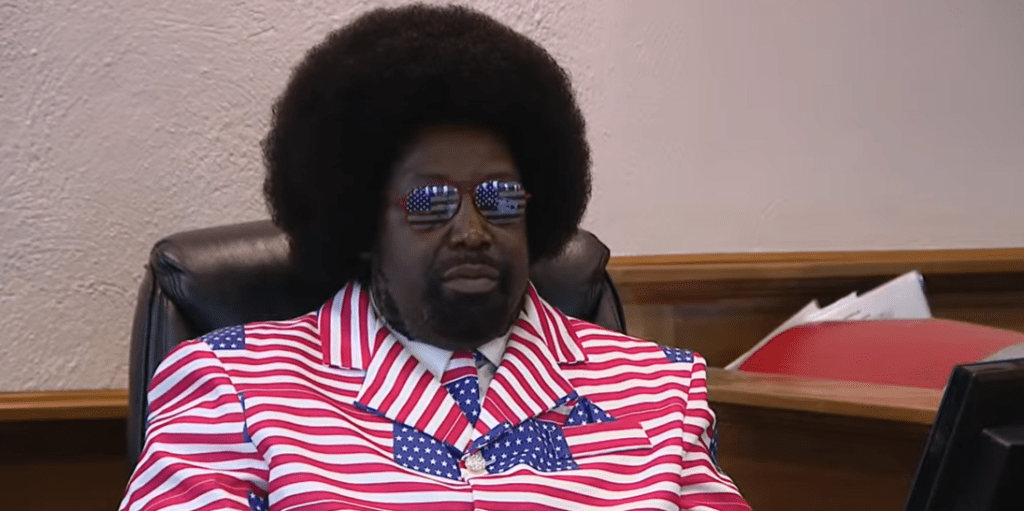
At first glance, the Adams County courtroom doesn’t appear to be very dramatic. Fluorescent lighting, wooden benches, and the soft sound of paperwork being moved. However, it has carried something more akin to tension than routine over the past few days—the kind that lingers after testimony concludes and people discreetly check their phones for updates.
At the center of it all is Afroman, a musician who gained notoriety for his irreverence and humor but is currently in a completely different light. A music video, a lemon pound cake, and a police raid that became a cultural flashpoint are the three main points of contention in the lawsuit brought by multiple sheriff’s deputies against him.
| Field | Details |
|---|---|
| Full Name | Joseph Edgar Foreman |
| Stage Name | Afroman |
| Age | 51 (as of 2026) |
| Famous For | “Because I Got High” |
| Location of Case | Adams County, Ohio, USA |
| Case Type | Defamation & Invasion of Privacy Lawsuit |
| Plaintiffs | Adams County Sheriff’s Deputies |
| Trigger Event | 2022 police raid on Afroman’s home |
| Core Issue | Use of officers’ likeness in music videos |
| Reference | https://www.aclu.org/cases/cooley-v-foreman-aka-afroman |
The story starts in 2022 when his Ohio home was raided by deputies looking for evidence of kidnapping and drugs. Nothing was discovered. There were no charges after that. However, more than just inconvenience was left behind by the physical aftermath, which included broken doors, disturbed rooms, and missing money. Afroman used music, his specialty, to fill the narrative void it created.
Now that I’m watching the videos, I can see how raw they are. A camera captures someone looking at a cake on the kitchen counter in grainy surveillance footage of officers patrolling his home. It’s strangely personal, almost unsettling. Millions of people watched, though, laughed, and shared.
On the other hand, the deputies witnessed something completely different: mockery, humiliation, and what they say is reputational harm. As they sat in court, some of them talked about the fallout in intimate terms, citing public harassment and family strife. According to reports, one officer sobbed as the video was playing. It’s difficult to ignore how bizarre that scene must have seemed—a courtroom being transformed into a screening space for a satirical song.
Afroman hasn’t held back in his response. If anything, it has become more rebellious. He seems more like an artist refusing to edit his work mid-performance than a defendant attempting to soften perceptions, as evidenced by his posting of new videos, mocking testimony, and intensifying his interpretation of events.
He seems to really think that this is about free speech. He allegedly presented the entire situation in court as a result of the raid, claiming that none of this would have happened otherwise. It’s a straightforward, almost direct argument. However, legal clarity isn’t always a direct result of simplicity.
When observing the case, legal experts seem divided, or at the very least wary. In the US, there is a high standard for defamation involving public officials, particularly when satire and artistic expression are involved. Restricting this type of speech could create an awkward precedent, according to groups like the ACLU. However, it’s not completely simple. The distinction between personal attack and parody is rarely clear-cut.
The case has taken on a life of its own outside the courtroom. Videos on social media spread more quickly than official updates. People quickly take sides, frequently without fully comprehending the nuances of the law. Afroman is perceived by some as a provocateur who challenges authority. Some see it as a careless use of actual people for entertainment.
Both interpretations might have some validity. Additionally, the entire conflict has a distinctly contemporary quality. Home cameras captured a police raid. An answer that became viral. A lawsuit, developing in real time with commentary and memes. The lines separating individual experience, public discourse, and legal ramifications seem more hazy than they used to.
As this develops, there’s a sense that the precedent it suggests may be more important than the result. What does it mean for documentary-style expression if artists are prohibited from using actual footage of public officials? But where does accountability start if people are the focus of viral mockery?
In the end, the jury will consider these issues from a legal perspective. They will examine the evidence, hear testimony, and attempt to draw a line that complies with the law. However, the conversation is already much less certain, messier, and more expansive outside of that room.
For the time being, the courtroom is still in operation, the videos are still making the rounds, and Afroman—suit, sunglasses, and all—continues to handle the entire situation with a combination of gravity and spectacle. Although this is an odd position, it has never been the norm. And maybe that’s the point.
