

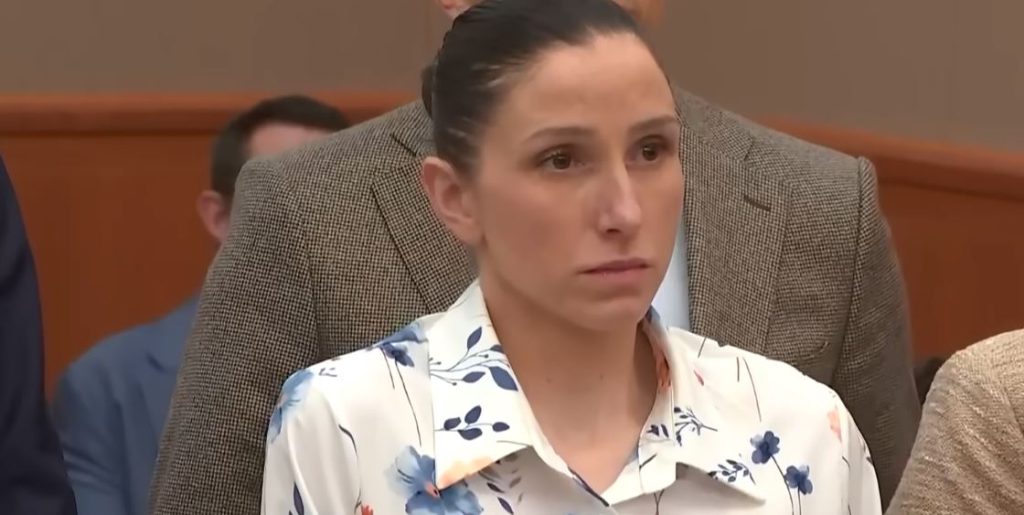
Park City’s courthouse is situated against a setting that seems almost too calm for the events that took place within. Quiet streets, snow-covered mountains in the distance, a serenity typically associated with weekend getaways and ski tourists. However, over the past few weeks, that serenity has been broken up by something heavier: early crowd formation, reporters adjusting cameras, and families entering with expressions that seemed to be stuck between hope and dread.
The crime wasn’t the only reason Kouri Richins’ trial garnered attention. What persisted were the inconsistencies. a mother of three. A woman who wrote a book about grief for young readers. And in the middle of it all was a husband who had died from a fatal fentanyl dose. It’s difficult to ignore the story’s eerie symmetry, which gave the impression that real life had appropriated too much from fiction.
| Category | Details |
|---|---|
| Full Name | Kouri Richins |
| Age | 35 (at time of trial) |
| Location | Park City |
| Occupation | Real estate agent, self-published author |
| Victim | Eric Richins |
| Crime | Poisoning with fentanyl (March 2022) |
| Charges | Aggravated murder, attempted murder, fraud, forgery |
| Verdict | Guilty on all counts (March 2026) |
| Notable Detail | Published children’s grief book after husband’s death |
| Reference | https://www.cnn.com |
The atmosphere in the courtroom was said to be tense, almost guarded. Over the course of almost two weeks, jurors heard testimony from over forty witnesses, ranging from highly personal to technical. Fentanyl was found, according to toxicology reports. The clinical portion was that. Then, however, came the text messages, the silent confessions, the shattered pieces of a marriage that appeared to be falling apart long before anyone outside could see it.
A particular incident from the trial keeps coming up. A housekeeper recounts how she was asked to get pills, first a mild one and then a stronger one. The development seemed intentional, almost systematic. Nevertheless, the defense retaliated, casting doubt on credibility, highlighting holes, and speculating that what appeared to be intent might actually be a coincidence. Even though the verdict was rendered rather quickly, it’s possible that jurors found it difficult to sort through those conflicting narratives.
The marriage itself is what makes everything more difficult. Friends characterized it as tense, molded by fears and financial strains. Prenuptial agreements and concerns about the potential consequences of a divorce were mentioned. According to one testimony, Richins felt “trapped,” a term that is more likely to be used in court than others. It’s another matter entirely whether that emotion translates into motivation, but it undoubtedly shaped the prosecution’s narrative.
The book comes next. The title “Are You With Me?” now has a new meaning. It was written—or possibly put together—after Eric Richins passed away and offered as a coping mechanism for her kids. As this develops, it seems as though the book has evolved beyond a mere detail. It became a symbol that raised concerns about authenticity, timing, and even intent. Whether the jury interpreted it as proof of grief or something else entirely is still unknown.
After only a few hours of deliberation, the verdict was rendered. guilty in every way. While some onlookers were taken aback by the speed, others appeared to anticipate it. Once a narrative takes hold, juries can move quickly in cases like this, where a large portion of the evidence is circumstantial but layered. That seems to have occurred here, though it’s still unclear exactly what tipped the scales.
Quiet waves of reactions developed outside the courthouse. The family of Eric Richins expressed a muted sense of relief that acknowledges closure but does not erase loss. Fewer but still present, Kouri Richins’s supporters appeared shocked. It’s difficult to ignore how tragedies like these split entire communities as well as families, leaving a legacy of unresolved issues.
Beneath the surface, something more extensive is also taking place. Cases like this get national attention almost immediately, making true crime a sort of cultural currency. Long before verdicts are read, people follow every detail, discuss the evidence online, and form opinions. It seems as though the courtroom was just one stage of the Richins trial, with the other existing through screens, comments, and late-night conversations.
However, the case’s core is still very personal. Now, three kids are growing up under the shadow of a narrative they didn’t choose. A family changed in ways that don’t neatly fit into court rulings. The fact that sentencing is still pending and that appeals are probably in store indicates that the legal chapter is not quite over.
However, something has changed. Even though there are still unanswered questions, the story has solidified into a conclusion. Over time, more information might come to light, changing our understanding of this case. Or maybe it will fall into the unsettling category of tales that seem resolved on paper but are still difficult to recall.
As this develops, there is a persistent feeling that the trial was about more than just establishing the facts. It was about trying to make sense of something that still defies easy explanation.
