

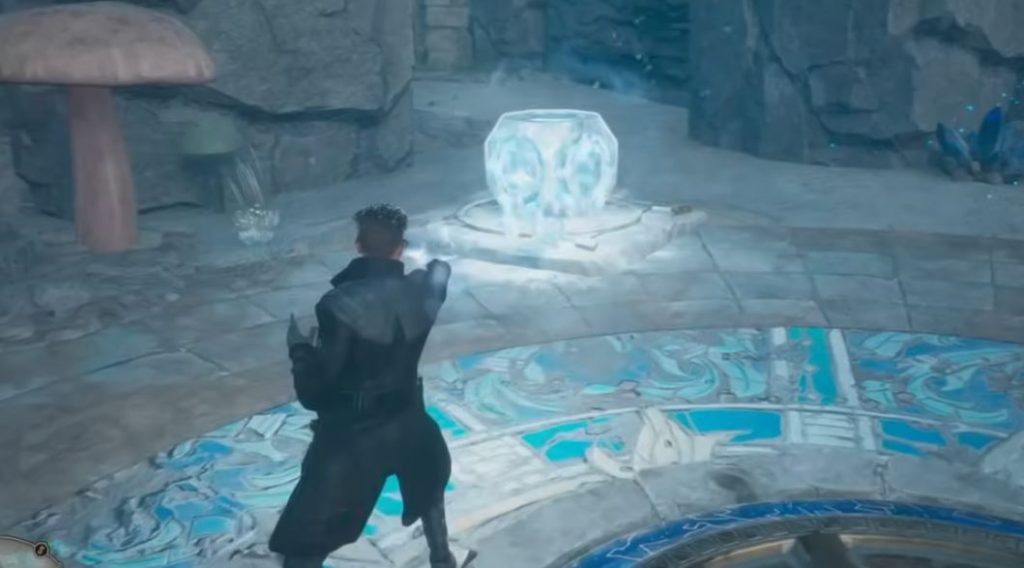
When Hogwarts Legacy first debuted in 2023, the anticipation was almost theatrical. The game swiftly surpassed 20 million copies sold, streams glowed, and fans strolled through the castle corridors like tourists in a virtual museum.
However, you also started to notice the boundaries if you spent enough time in its world, such as flying over the Black Lake or exploring the more sedate hallways late at night. Yes, the systems were well-maintained, but the world seemed a little stagnant. Pupils were positioned in predictable ways. The battle was repeated. Players eventually began speculating about what else Hogwarts might be. The Goblet mod discreetly intervened in that situation.
Hogwarts Legacy: The Goblet Mod
| Category | Information |
|---|---|
| Game Title | Hogwarts Legacy |
| Developer | Avalanche Software |
| Publisher | Warner Bros. Games |
| Original Release | February 10, 2023 |
| Game Engine | Unreal Engine 4 |
| Genre | Action RPG, Open-World |
| Major Fan Mod | The Goblet Overhaul / Goblet Mod Collection |
| Mod Platform | Nexus Mods |
| Estimated Mod Size | ~4 GB collection with 100+ additions |
| Reference Website | https://www.nexusmods.com/hogwartslegacy |
The Goblet appears to be just another mod collection at first glance. However, the difference is noticeable within minutes of installation. The castle seems more crowded. Moving between classes, the Great Hall, and common areas is more routine for NPC students. After dinner, employees get together. The castle feels less like a stage set and more like a living school because some students even change into pajamas at night. There’s an odd feeling that the game has finally started to breathe as you watch it develop.
The Goblet is a comprehensive overhaul with over a hundred tweaks, tools, and gameplay changes rather than a single mod. Building on the work of several other modders, 2077v2, the creator of Nexus Mods, assembled a large portion of it. It appears that immersion is more important than ostentatious additions. Custom reshade settings provide subtle improvements to the graphics while improving the interface’s responsiveness and cleanliness. More customization options are available for characters, and an outfit studio lets players change clothes almost instantly—something that was strangely limited in the original game.
The actual shift, however, occurs during gameplay. The Goblet’s difficulty presets change the combat balance in unexpectedly significant ways. Spell cooldowns are uncomfortably long on the “Nightmare” preset, and enemies hit harder and take longer to defeat.
Encounters that used to seem ordinary, like a group of dark wizards in the Forbidden Forest or a troll wandering outside Hogsmeade, suddenly become tense. This might be more in line with what gamers had in mind when they heard the term “wizard dueling RPG.” These days, the battles demand patience and occasionally even strategy.
The opposite is true for other presets. One version, obviously intended for players who want to explore without having to go through the map again, instantly unlocks every Floo travel point and increases inventory space. It’s a very adaptable system, as if the modders realized that players of Hogwarts Legacy have very different approaches to the game.
When you walk around Hogsmeade with the mod installed, you notice something else. The actions of NPCs seem less robotic. People in the town stroll more freely, their conversations overlap, and now and then a tiny moment—a student rushing across the square as if they are running late for class—catches the eye. Even though these changes are small, they add up. The world seems more like a place where time passes than a backdrop.
It’s difficult not to question why some of these concepts weren’t included in the original game.
Development realities likely hold part of the answer. Under tremendous pressure, Avalanche Software created a vast world, and it was never feasible to polish every system equally. However, modders operate differently. One mechanism at a time, they experiment freely and occasionally break things in the process. The Goblet seems to be the outcome of hundreds of these tiny experiments coming together gradually.
Additionally, timing is important. The modding community has successfully filled the void between official releases, with rumors circulating about a possible Hogwarts Legacy sequel for the latter half of the decade. Some players now regard the Goblet as the “director’s cut” version of the game, which is unquestionably richer but not formally approved.
Additionally, this has a very contemporary cultural component. Nowadays, games rarely stay frozen after release. Rather, they change through community creativity, fan projects, and patches. It was done years ago by Skyrim. Eventually, cyberpunk emerged. It seems strangely inevitable to see Hogwarts Legacy go through a similar metamorphosis.
Modding is not without its challenges, though. When new game patches are released, compatibility problems can occasionally arise, and players sometimes report having to change versions or disable specific features. The cost of experimentation is that. However, the Goblet project community appears surprisingly patient, exchanging fixes and guidance on Discord and forums.
After spending a few hours inside this altered Hogwarts, the realization that the castle now feels like a school rather than merely a stunning setting comes to mind.
It’s unclear if Warner Bros. will ever use concepts from mods like this. Sometimes, studios keep a close eye on these communities and discreetly record which experiments players find appealing. It wouldn’t be shocking to see some Goblet-inspired features incorporated into the official design if a sequel is eventually released.
Until then, this fan-made redesign is in an odd place, halfway between an unofficial sequel and an expansion pack.
And that seems to be more than enough for a lot of players strolling through Hogwarts’ hallways once more.
