

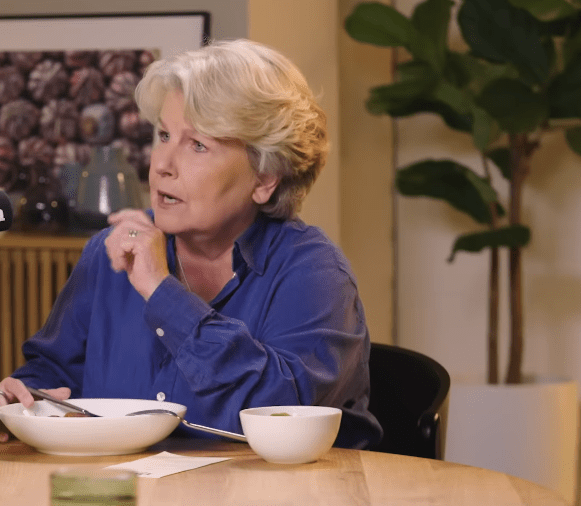
Credit: Dish Podcast
While touring Australia in December 2022 with a show based on astute observations and quick timing, Sandi Toksvig ran into a much less cooperative partner: bronchial pneumonia, which struck unexpectedly and forcefully interrupted her schedule.
Following appearances in Sydney, Melbourne, and Adelaide, fatigue gradually but obstinately set in, turning what appeared to be ordinary exhaustion into something far more serious, necessitating hospitalization and the cancellation of her New Zealand engagements.
| Full Name | Sandra Birgitte Toksvig OBE |
|---|---|
| Born | May 3, 1958, Copenhagen, Denmark |
| Profession | Broadcaster, writer, comedian, political activist |
| Career Highlights | Host of QI (2016–present), Great British Bake Off co-host (2017–2020), co-founder of Women’s Equality Party (2015) |
| Notable Health Event | Hospitalized with bronchial pneumonia in December 2022 while touring in Australia |
| External Reference | HuffPost UK coverage of Toksvig’s illness |
For someone whose profession depends so heavily on breath, voice, and sustained energy, bronchial pneumonia, which involves acute inflammation of the bronchi and surrounding lung tissue, can be extremely destabilizing even though it doesn’t have a dramatic effect.
In an industry that frequently encourages performers to continue regardless, her team prioritized her recovery over applause and released statements centered on getting her home safely. This was a remarkably responsible and forward-thinking decision.
Upon returning to the UK, Toksvig was confronted with a sobering reality. She had trouble walking. Her steps were supported by two sticks, and even short distances felt excessively taxing, as though her body had adjusted overnight.
She later spoke candidly about those early days in interviews, stating that five minutes outside was sufficient at first—a modest standard that seemed surprisingly ambitious at the time.
The forest followed.
She bought a neglected forest patch with her wife Debbie, not as a side project but as a working landscape that required care, perseverance, and steady hands.
For Toksvig, the choice seemed more instinctive than calculated, despite the fact that restorative projects such as this one have garnered attention recently for their particularly positive effects on mental and physical health.
She went outdoors every day, taking her time, breathing deeply, and gradually increasing her stamina in tiny but significant steps.
the first five minutes. Then ten. Later, strength returned in noticeably better rhythms rather than with sudden, dramatic leaps.
It feels poetic and incredibly clear what she means when she says that the woods “acted as a nurse” to her recovery.
She changed from a patient to a participant, from someone receiving treatment to someone actively rebuilding, as she worked among trees, removing brush, and repairing pathways.
She discovered one afternoon that she had lost her walking sticks and was using a chainsaw instead, moving with assurance that would have seemed unthinkable just a few weeks before.
It’s a persistent detail.
When I first read that line, I recall halting because I was so taken aback by how subtly triumphant it sounded without requesting cheers.
In contrast to scripts and studio lights, this recovery was tactile, physical, and rooted in bark and soil for someone who is known for their quick wit and intellectual agility.
Her career has been remarkably consistent, from taking over QI in 2016 to co-hosting The Great British Bake Off and co-founding the Women’s Equality Party. However, the illness forced a pause that no scheduling conflict could ever force.
Her career has been immensely varied over the years, involving live performances, writing, political activism, and broadcasting—all of which call for endurance and a keen mind.
However, pneumonia does not bargain with adaptability. It requires silence.
Her absence from public during that time of enforced silence was evident, but it was handled politely; ticket holders received refunds, statements were given, and expectations were managed with incredibly dependable professionalism.
Melodrama was not present. No big reveal of change.
Instead, the work was surprisingly practical and almost meditative, involving daily labor in a forest, clearing undergrowth, restoring biodiversity, and strengthening lungs.
By performing manual labor, walking uneven terrain, lifting timber, breathing cold air, and gradually increasing capacity, she developed a recovery process that was incredibly effective in its simplicity.
Many public personalities use illness as a plot point, sometimes exaggerated or presented as fate. Toksvig’s strategy seemed distinct, realistic, grounded, and progressive.
She didn’t show signs of weakness. She claimed to be rebuilding.
Gradual physical activity can be extremely beneficial for long-term health, especially following respiratory illness. It can improve cardiovascular function and boost self-confidence in endurance.
Her woodland restoration series, which was later aired on Channel 4, integrated recovery and regeneration in a way that felt especially novel, documenting not only environmental repair but also individual resilience.
As the forest gradually changed from being neglected to being meticulously cared for, viewers witnessed her working, planning, and occasionally reflecting while constantly moving forward.
The symbolism was clear but not overbearing.
With time and effort, a damaged system can become noticeably stronger.
This quieter setting revealed a different cadence, calmer but no less purposeful, for audiences used to seeing her standing under studio lights or seated behind a desk of facts.
Her voice, which had been strained by illness, sounded steady once more. Her breath was controlled, and her delivery was measured but distinctively hers.
Her presence has appeared to have been subtly rebalanced since she resumed her regular appearances, as though the experience had removed needless urgency and replaced it with purposeful focus.
Illness can reveal vulnerabilities that are remarkably similar across professions, especially when it completely disrupts routine. This serves as a reminder to even seasoned performers that biology has its own schedule.
It can, however, also reveal capacity.
Toksvig’s recovery was incredibly resilient, developed day by day, step by step, tree by tree, but it was not a Hollywood production or presented as a miraculous recovery.
She will probably keep striking a balance between environmental restoration and broadcasting in the years to come, fusing academic achievement with hands-on stewardship in a way that feels genuine and sustainable.
Her narrative makes the subtly compelling argument that setbacks can serve as starting points for renewal rather than as ends in and of themselves if they are handled carefully and persistently.
The woodland remains, serving as living proof that recovery, when approached with patience and optimism, can be both transformative and enduring, even though the stage lights may return, tours may resume, and scripts may get sharper.
