

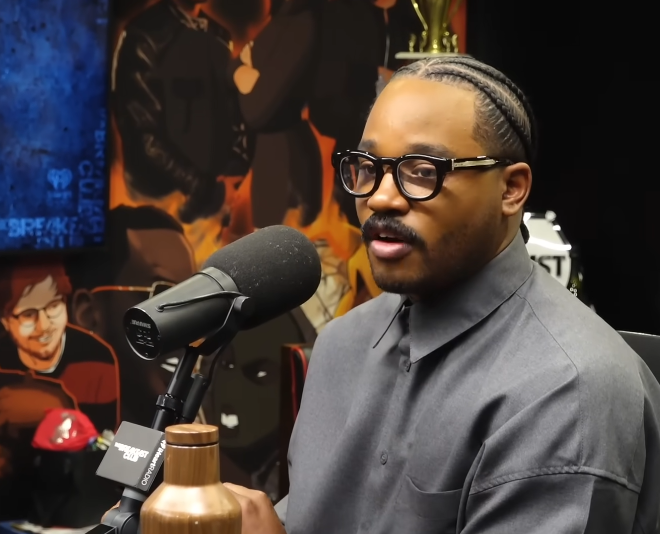
Credit: Breakfast Club Power105.1 FM
Almost immediately following Ryan Coogler’s handcuffing inside an Atlanta Bank of America branch in January 2022, the word “lawsuit” was in the news. It seemed almost procedural, inevitable. a well-known director. A shameful public error. cameras on police bodies. The company apologizes. It appeared that the sequence was intended to conclude in court.
Rather, it came to a brief halt.
While working on Black Panther: Wakanda Forever, Coogler had been trying to take $12,000 out of his personal account. In a note, he asked the teller to discreetly count the money—a small, cautious gesture that anyone who has dealt with big sums of money in public might recognize.
| Key | Details |
|---|---|
| Name | Ryan Coogler |
| Background | Born in Oakland, California; filmmaker known for socially grounded, politically aware storytelling |
| Career Highlights | Fruitvale Station (2013), Creed (2015), Black Panther (2018), Black Panther: Wakanda Forever (2022) |
| Incident Context | Detained by Atlanta police in January 2022 after a Bank of America teller mistakenly suspected attempted robbery |
| Legal Outcome | No lawsuit filed; Bank of America issued an apology |
| External Reference | CNN |
Suspicion was aroused by that note. A quiet warning. a call to 911. Officers showed up promptly.
One of the officers unholstered a gun inside the bank for a moment. Coogler was handcuffed by another. Two coworkers who were waiting outside in a running SUV were taken into custody and placed in the rear of a patrol car. The premise was incorrect, but the scene played out with the serene efficiency of a drill.
Coogler “was never in the wrong,” according to the police report, which was later made clear. Bank of America expressed regret. A mistake was admitted by the Atlanta Police Department. The handcuffs were removed.
Racial profiling made headlines in the days that followed, and with good reason. In the video, a 35-year-old Black filmmaker calmly identified himself, pointing to his ID and advising police to “just put it in Google.” That line’s bizarre quality persisted longer than the actual event.
Many were surprised by what didn’t happen. No lawsuit was filed.
In a brief statement, Coogler claimed that the incident should never have occurred, that he was satisfied with the bank’s handling of it, and that he had moved on. The restraint seemed almost countercultural to a public used to such encounters turning into court cases.
The expectation was partially based on precedent. Settlements are a common way for corporations to address high-profile errors, sometimes in secret and sometimes following years of legal action. Lawsuits are one of the few tools available to compel institutional change, as civil rights lawyers frequently point out.
However, Coogler turned that option down.
It would be easy to characterize that choice as either exhaustion or generosity, but neither quite works. Examining systems—policing, housing, masculinity, and legacy—without reducing them to heroes or villains has been Coogler’s specialty. His movies focus more on the aftermaths than the climaxes.
The story would have moved into well-known territory with a lawsuit: damages, discovery, and negotiated language. The incident would have been reduced to terms and figures.
The incident remained awkwardly human in the absence of a lawsuit.
The anonymous and now-famous teller at Bank of America allegedly thought she was following procedure following an account alert. The officers responded to a call they believed to be legitimate. Every action had a process, and none of them needed malicious intent to go wrong.
That’s where the discomfort lies. There isn’t a single bad actor to single out. Just a system that misinterprets some bodies more easily than others.
Years later, when I watched the video again, I recall feeling less shocked and more like I recognized it.
Coogler was surrounded by additional legal issues at the same time. He was named in a different lawsuit accusing him of stealing ideas from the Creed franchise, along with Sylvester Stallone and MGM. The more traditional Hollywood route—claims, denials, lawyers, and protracted uncertainty—was followed in that case.
The difference was important. One disagreement concerned credit and ownership. The other concerned suspicion and safety.
Only one prompted calls for punitive action from the general public.
Some detractors claimed that by not filing a lawsuit, a chance was lost. They claimed that a well-known plaintiff might have established a financial precedent or compelled policy changes. I’m sorry, but training manuals shouldn’t be rewritten.
The decision was viewed as practical by others. Time, attention, and emotional energy are all taken away by lawsuits. After Chadwick Boseman’s death, Coogler was in the midst of completing a film under extraordinary circumstances. There wasn’t much room for distraction.
The more subdued reality is that personal closure is not always a result of legal victories. The sound of a gun leaving its holster or the memory of cold cuffs are not erased by being correct on paper.
Coogler has discussed accountability and self-control, as well as where to apply pressure, in interviews unrelated to the incident. Not all injustices require the same reaction. Every wound heals differently.
The story didn’t go away just because there was no lawsuit. It was discussed in private conversations, op-eds, and training seminars. It evolved into shorthand. People would ask, as though narrating a parable rather than a news story, “Do you remember what happened to Ryan Coogler?”
It might have been the purpose of that enduring cultural presence.
Banks discreetly reviewed procedures pertaining to discretionary cash withdrawals. During conversations about call verification, police departments referred to the video. There were no settlements or press releases associated with any of this.
Resolution is essential to the legal system. It was resisted by this incident.
People often assume that the most prominent response is the most significant, and they equate justice with escalation. That presumption was challenged by Coogler’s decision. Observers were left feeling more uneasy and with fewer talking points.
This could be the reason why, years later, the word “lawsuit” still appears after his name in search results and social media feeds, as though people are anticipating a sequel that never materialized.
An unresolved discomfort can feel like a failure in a media landscape that is addicted to arcs and outcomes. Sometimes, though, it’s a mirror.
In Atlanta, the handcuffs were swiftly removed that day. The bigger queries didn’t.
