

This is not how quickly the car market typically moves. It requires a fuel crisis, a recession, or occasionally an industry-surprising regulation. However, the current situation in showrooms in Hamburg, Milan, Hanoi, and a small area southwest of London feels different. The response to the Iran War has been quicker, messier, and more revealing than most analysts anticipated. This is because the war has put an end to cheap gasoline.
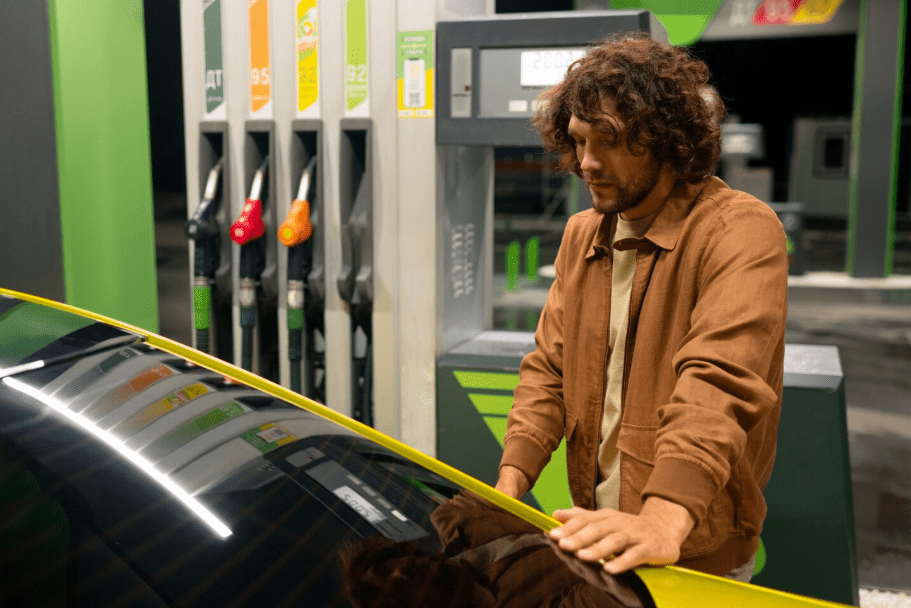
By the end of April, Brent crude had surpassed $100 per barrel, and gasoline followed suit as usual: swiftly, painfully, and visibly. It was the biggest supply disruption in the history of the world oil market, according to the IEA. That statement sounds almost theatrical until you watch the line at a gas station on a Sunday afternoon and hear someone calculate whether the commute the following month will even be worthwhile.
Martin Miller, the owner of EV Experts, a used-EV dealership in Guildford, told Reuters that his employees have been purchasing inventory at auction “like mad.” One week after the start of the war, he had his busiest Saturday ever. Like someone describing a flood that finally arrives at their door, he said it casually. Zach Xavier, a customer, entered a used-EV lot in Richmond, Virginia, traded in his combustion SUV, and that same afternoon purchased a second, smaller EV. “I’m trying to get in before everybody freaks out,” he replied.
The European figures provide a clearer picture. In March, EV sales increased by 51% throughout the continent. Italy, which has always been allergic to electricity, saw a 65% increase from the previous year. Germany saw a 42% increase as Chinese EVs are currently arriving faster than its own factories can adjust. In April, 96% of private consumers in Denmark opted for electric vehicles. Naturally, Norway scored 98%. Even if it’s more appropriate to refer to it as a “midterm shift” than a turning point, there’s a sense that something has changed.
The picture becomes more intriguing outside of Europe. VinFast, a company based in Vietnam, reported a 127% increase in sales in March, which was attributed to discounts that the company specifically marketed as relief from “volatility in global fuel prices.” The biggest coal exporter in the world, Indonesia, declared a push to increase domestic EV production. What would have otherwise been a catastrophic energy shock was mitigated by Pakistan’s ongoing solar boom. These dispersed movements could be the beginning of a coordinated action. It’s also possible that they are reading in the same room from different countries.
The American perspective is steadfastly different. Last year, just 7.7% of new cars were EVs, and the Trump administration’s decision to eliminate the $7,500 federal tax credit hasn’t helped. According to Cox Automotive’s research, before American consumers make a significant shift, gas prices would need to reach $6 per gallon and remain there for at least six months. Although uncomfortable, the current average of $3.72 doesn’t seem to be uncomfortable enough. With tens of billions in write-offs, Ford, GM, and Stellantis have retreated from their EV aspirations. To put it mildly, the timing is awkward.
More than anything else, Iran’s war has served as a reminder that the cost of operating a gasoline-powered vehicle was never truly stable; it was merely predictable enough to be disregarded. The predictability has now vanished, and the showrooms are quietly dealing with the fallout. It’s still genuinely unclear if this turns out to be the structural shift analysts have been waiting for or if it’s just another spike that fades when the headlines do. However, the question feels open for the first time in a long time.
FAQs
Q1: How much have oil prices risen due to the Iran war?
Brent crude has surged above $100 a barrel.
Q2: Why are EV sales jumping in Europe?
High petrol prices have made EVs far cheaper to run.
Q3: Which country leads EV adoption in 2026?
Norway, with 98% of new car sales being electric.
Q4: Is the US seeing the same EV boom?
No, US petrol prices haven’t risen high enough yet.
Q5: Will this EV surge last long-term?
Likely yes, if oil prices stay elevated for several months.
